
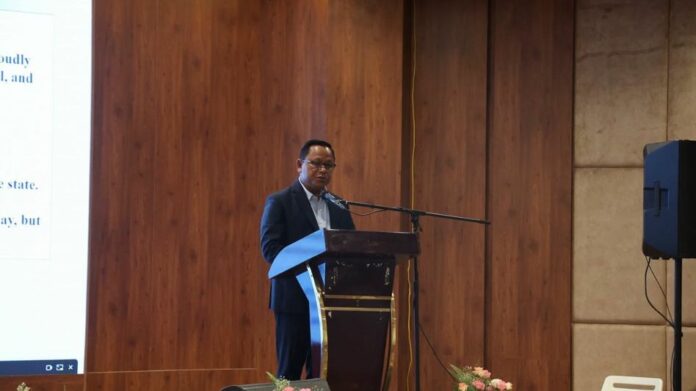
Meghalaya has increased rural tap water connectivity from 4,550 households, or 0.70 per cent, in 2019 to 5,47,077 households, covering 84.06 per cent of rural homes, Public Health Engineering Minister Marcuise N Marak said while launching the state-level Jal Utsav 2026 on July 21.
Launching the campaign, Marak described Jal Utsav as a “people’s movement” aimed at encouraging citizens to value, protect and conserve water for present and future generations.
Held under the theme “Celebrating Water, Securing Sources”, the campaign is based on the principles of Celebrate, Understand and Protect. Through Rajya Jal Utsav and Lok Jal Utsav, the initiative seeks to highlight Meghalaya’s water heritage, promote conservation and strengthen community ownership of rural drinking water systems.
The minister said 3,616 villages across the state had achieved Har Ghar Jal status. He credited engineers, field staff, district administrations, Village Water and Sanitation Committees and local communities for contributing to the achievement.
Marak said the extension of Jal Jeevan Mission 2.0 until December 2028 would shift the government’s focus from expanding infrastructure to ensuring reliable water services, sustainable water sources and greater community participation in managing rural water supply systems.
Outlining the department’s future roadmap, he highlighted three key initiatives aimed at building a water-secure Meghalaya. These include Sujalam Bharat, a digital platform for monitoring rural water systems; Jal Arpan Diwas, which seeks to strengthen community responsibility for water infrastructure; and Jal Utsav, which promotes public participation in water conservation.
“Jal Utsav marks the beginning of a long-term movement towards a water-secure Meghalaya,” Marak said, urging districts, villages, institutions and citizens to actively participate in the campaign.
Public Health Engineering Department Commissioner and Secretary Pravin Bakshi also unveiled the department’s annual calendar for Rajya Jal Utsav and Lok Jal Utsav, which will be held from July 2026 until early 2027.
The year-long programme will include water quality awareness campaigns, Field Test Kit demonstrations, laboratory visits, marathons, asset maintenance drives, school and college competitions, river clean-up campaigns, water budgeting exercises and Gram Sabha meetings focused on water governance.
Bakshi said the success of the campaign would be measured through stronger community ownership, protection of water sources and the long-term sustainability of rural water supply systems.
The launch programme also featured cultural performances and a testimonial from a Village Water and Sanitation Committee representative from Diengiong village. The representative said access to piped water under the Jal Jeevan Mission had significantly improved daily life by reducing the burden of fetching water and ensuring a reliable supply of safe drinking water.
