
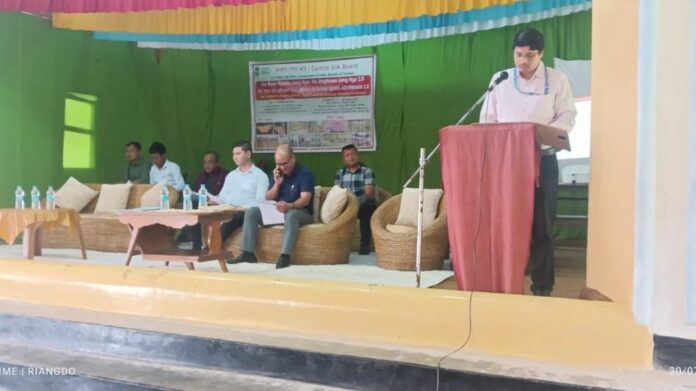
Shillong, August 1: A district-level stakeholder consultation on Muga and Eri development was held at Riangdo in Meghalaya’s West Khasi Hills to prepare a scientific and sustainable roadmap for expanding sericulture under the Mera Resham Mera Abhimaan (MRMA) 2.0 programme, with an emphasis on rural livelihoods, entrepreneurship and employment generation.
The consultation, organised at the Don Bosco Meeting Hall, was jointly hosted by the Central Silk Board’s Muga Eri Silkworm Seed Organization (MESSO), P-4 Unit, Mendipathar, and the District Sericulture Office, West Khasi Hills, under the Directorate of Sericulture, Government of Meghalaya.
Meghalaya Cabinet Minister and Mawshynrut MLA Methodius Dkhar attended the programme as the chief guest. The event brought together officials from the Agriculture, Horticulture, Forest, Rural Development, Sericulture and District Council departments, along with representatives of self-help groups, farmer interest groups, farmer producer organisations, entrepreneurs, local institutions and the media. Around 35 progressive farmers engaged in Muga, Eri and Mulberry cultivation across the district also participated.
District Sericulture Officer P. Warjri coordinated the programme, while Mahasankar Majumdar, Scientist-C and In-charge of the Central Silk Board’s MESSO P-4 Unit at Mendipathar, presented the proposed District Sericulture Development Plan under MRMA 2.0.
The proposed plan focuses on scientific Muga seed cocoon production through cluster-based plantation development, decentralised seed crop rearing, improved host plant management and scientific disease prevention. It also proposes convergence with government schemes, promotion of Eri value addition and the development of infrastructure to strengthen the district’s sericulture ecosystem.
Officials said the strategy aims to reduce production risks by encouraging small and manageable Muga plantations while promoting the adoption of scientific sericulture practices. The approach is expected to improve productivity, enhance cocoon quality and generate sustainable income opportunities for rural households.
Addressing the gathering, Dkhar welcomed the initiative of the Central Silk Board and the State Sericulture Department to prepare a comprehensive development roadmap for the sector. He stressed the need to expand livelihood opportunities, promote entrepreneurship, strengthen infrastructure and develop market-oriented sericulture to improve the economic prospects of farming communities.
The minister assured continued government support for initiatives aimed at strengthening the sericulture sector and creating sustainable employment opportunities, particularly for rural youth and women in West Khasi Hills.
Experts at the consultation highlighted the district’s favourable climatic conditions for producing Aherua and Bhodia Muga seed crops, noting that moderate temperatures contribute to higher silkworm survival and improved cocoon quality. They said these natural advantages position West Khasi Hills to emerge as a major Muga seed cocoon production hub in Meghalaya.
The consultation concluded with stakeholders reaffirming their commitment to work collectively towards the sustainable development of Muga, Eri and Mulberry sericulture in the district under the MRMA 2.0 programme.
