
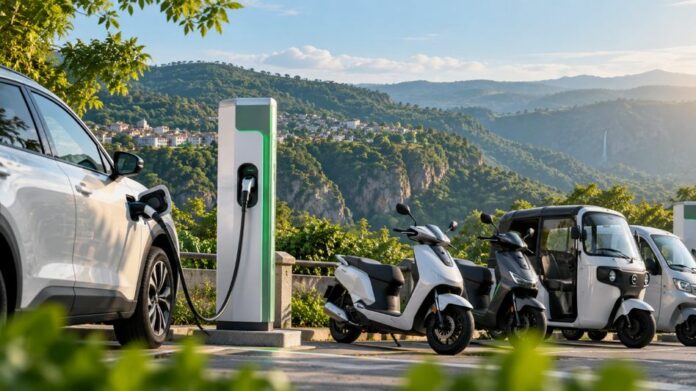
SHILLONG, Oct 21: The Meghalaya government has notified its Electric Vehicle (EV) Policy, 2026, introducing purchase incentives, exemptions on motor vehicle tax and registration fees, and scrappage benefits to encourage electric mobility across the state.
The policy, which will remain in force for three years from the date of notification in the Official Gazette, replaces the Meghalaya Electric Vehicle Policy, 2021. It also provides for expanding charging infrastructure, establishing battery-swapping facilities and attracting investment in the green mobility sector.
According to the policy, Meghalaya had around 6.53 lakh registered vehicles as of June 2026, including more than 2,500 electric vehicles. With road transport serving as the primary means of moving people and goods, the government aims to promote electric mobility in private and commercial transport, public transport, tourism and shared mobility services.
Purchase incentives will be available for eligible electric two-wheelers, three-wheelers and four-wheelers, subject to prescribed conditions, category-wise limits and fund availability. Benefits will be distributed on a first-come, first-served basis.
For electric two-wheelers priced up to Rs 1.75 lakh ex-factory, separate incentives have been earmarked for private and commercial buyers, with a limit of 2,000 vehicles in each category. Commercial electric three-wheelers, including auto-rickshaws and goods carriers, will also qualify, subject to a ceiling of 500 vehicles.
For electric four-wheelers priced up to Rs 35 lakh ex-factory, private buyers will be eligible for an incentive of Rs 25,000, while commercial buyers can receive Rs 50,000. The policy limits benefits to 3,000 vehicles each in the private and commercial categories.
Eligible electric vehicles registered in Meghalaya during the policy period will also receive exemptions from motor vehicle tax and registration fees. The benefits cover qualifying private and commercial two-wheelers, three-wheelers, four-wheelers and electric buses, subject to conditions prescribed by the Transport Department.
The policy also offers incentives to buyers replacing eligible older vehicles with new electric vehicles after scrapping end-of-life vehicles through an authorised Registered Vehicle Scrapping Facility. The scheme applies to qualifying BS-IV and older vehicles registered in Meghalaya, with applicants required to be the registered owners.
Eligible electric two-wheeler buyers can receive Rs 10,000, with benefits limited to the first 400 applicants. Electric three-wheeler buyers can receive Rs 25,000, subject to a cap of 50 applicants.
For electric four-wheelers, private buyers will be eligible for Rs 50,000 and commercial buyers for Rs 2 lakh, with a limit of 300 applicants in each category.
Expanding charging infrastructure is another key component of the policy. The Transport Department will coordinate with the Meghalaya Power Distribution Corporation Limited (MePDCL), Tourism Department, Urban Affairs Department, Public Works Department, local bodies and other stakeholders to identify suitable sites, assess electricity requirements and establish charging stations and battery-swapping facilities in phases.
Electricity supplied to public EV charging stations will be charged at tariff rates notified by the competent authority.
To attract private investment, the government may make suitable government land available on lease or through other notified arrangements for public charging stations, subject to availability and applicable conditions. Applications for charging stations, battery-swapping facilities and other eligible projects may also be facilitated through the Invest Meghalaya Portal’s Single Window System to streamline approvals.
The policy encourages start-ups, private investors and other enterprises to establish businesses linked to electric mobility. Eligible ventures may seek benefits under schemes such as the Uttar Poorva Transformative Industrialisation Scheme (UNNATI), 2024, and the Meghalaya Industrial and Investment Promotion Policy (MIIPP), 2024, subject to their respective eligibility criteria.
Potential areas for investment and employment include charging infrastructure, battery management and swapping services, vehicle servicing, fleet operations, digital mobility solutions, research and development, pilot projects and skill development.
Government departments, public sector undertakings, private companies, start-ups and institutions can submit proposals to the designated nodal agency. Proposals will be assessed on their alignment with the policy’s objectives, technical feasibility, financial viability, environmental benefits and potential contribution to EV adoption.
The Commissioner of Transport has been designated as the nodal agency responsible for implementing, administering and monitoring the policy.
A State Level Committee will be constituted under the chairpersonship of the senior-most Secretary in charge of the Transport Department. It will include representatives from the Transport Department, Finance Department, Planning Department, Directorate of Commerce and Industries, Meghalaya Energy Corporation Limited and other nominated departments or institutions.
The committee will examine incentive and subsidy claims, consider infrastructure proposals, monitor implementation, recommend changes and address grievances and disputes relating to the policy.
Eligible buyers can apply for purchase incentives through the Meghalaya EV Subsidy Portal. The nodal agency will prescribe documentation requirements, application procedures and processing timelines through separate operational guidelines.
The government has reserved the right to modify the policy in the public interest. It aims to reduce dependence on fossil fuels, improve air quality and encourage investment and employment in Meghalaya’s electric mobility sector.
