
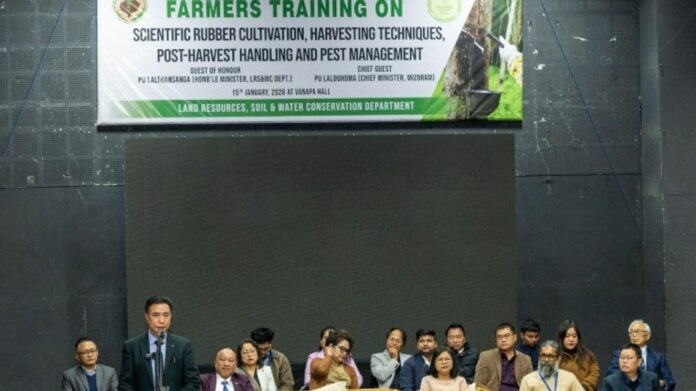
Aizawl, Jan 16: Mizoram is stepping up efforts to establish itself as a leading rubber-producing state, with Chief Minister Lalduhoma on January 15 citing positive progress under the Chief Minister’s Rubber Mission launched in 2024.
Addressing a training programme on scientific rubber cultivation, harvesting methods, post-harvest management and pest control, Lalduhoma said the mission was designed after extensive consultations with the Rubber Board of India and a review of the successful Tripura Rubber Mission to ensure a structured and systematic approach.
The Chief Minister said the mission’s progress had exceeded initial expectations, crediting the strong and growing interest among farmers who were increasingly adopting rubber cultivation. He observed that despite being a Union Territory for over five decades, Mizoram had lacked a crop that could give the state a distinct agricultural identity.
Lalduhoma said this situation began to change after the Zoram People’s Movement government came to power and implemented targeted policies, leading to Mizoram being recognised by NITI Aayog as the ‘Ginger Capital of India’. He added that passion fruit, locally known as Sapthei, also holds significant promise, while rubber has the potential to anchor a sustainable agricultural identity for the state.
Officials said Mizoram has nearly 50,000 hectares of land suitable for rubber cultivation, and the government has prioritised the crop for its environmental and economic advantages, including afforestation, water conservation, timber value and favourable market prospects.
The Chief Minister’s Rubber Mission was formally launched on October 18, 2024, with implementation by the Land Resources, Soil and Water Conservation Department beginning in early 2025. So far, about 4.5 lakh rubber saplings have been planted over more than 1,000 hectares in Mamit district, which borders Tripura and Bangladesh, and Kolasib district, which shares a boundary with Assam.
During the current year, officials said over 11.58 lakh saplings are planned to be planted across 2,575 hectares in various districts. Infrastructure support under the mission will include approach and link roads to plantations, supply of rubber roller machines and tapping tools, and assistance with marketing. This year, approach and link roads covering 46.50 km are proposed at 11 rubber plantation sites across the state.
The ongoing training programme, conducted by subject experts, is expected to train around 550 rubber growers in scientific cultivation practices, tapping techniques, rubber sheet processing, post-harvest handling and pest management.
