
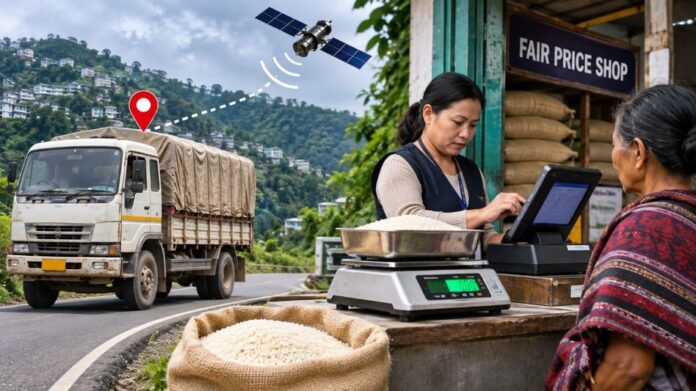
Mizoram will make GPS tracking mandatory for trucks transporting ration rice and introduce digital weighing systems at fair price shops to prevent diversion and ensure beneficiaries receive their full entitlement, Food, Civil Supplies and Consumer Affairs Minister B Lalchhanzova said on Thursday.
Under the proposed arrangement, all trucks carrying ration rice will have to be equipped with GPS devices meeting AIS-140 standards. Their movements will be monitored through the department’s command and control room, and vehicles without the prescribed tracking equipment will not be allowed to transport ration rice.
As a temporary measure, transporters will be permitted to use a mobile application-based tracking system developed jointly by the Centre and the World Food Programme until the mandatory GPS system is fully implemented. Lalchhanzova said the new mechanism was expected to become operational by the end of December.
The department will also integrate electronic point-of-sale (ePoS) machines with digital weighing scales at all fair price shops. The move is intended to ensure that the quantity registered electronically corresponds with the actual amount of rice distributed, preventing under-weighing and fraudulent transactions in which ration is recorded as distributed without reaching beneficiaries.
The minister said retailers had completed training for the November distribution cycle. However, 263 fair price shop retailers facing internet connectivity issues or equipment-related difficulties had been permitted to continue with the existing system temporarily.
The government has also revised the margins for ration retailers and transportation charges. The margin for Antyodaya Anna Yojana and Priority Household (PHH) beneficiaries under the National Food Security Act has been raised to Rs 3 per kg. For PHH (Additional), Non-NFSA and Mizoram State Special Ration Package (MSSRP) categories, the margin has been set at Rs 2 per kg from October.
Meanwhile, the transportation rate for retailers undertaking town trips has been increased from Rs 50 to Rs 75 per quintal.
Lalchhanzova said the state was working towards digitising its entire rice distribution network through three systems — the Supply Chain Management System, Route Optimisation Tool and Vehicle Location Tracking System. The Route Optimisation Tool will identify shorter transportation routes, while the Vehicle Location Tracking System will facilitate real-time monitoring of trucks. These systems will collectively track rice movement from one godown to another and ultimately to fair price shops.
Mizoram requires approximately 91,000 quintals of rice every month for ration distribution. Of this, 54,798.33 quintals are provided free of cost by the Food Corporation of India under the National Food Security Act, while the state purchases around 36,000 quintals from the open market, the minister said.
The state government is also planning a significant reduction in open-market rice procurement during the current financial year.
For 2026-27, procurement is estimated at 3,34,114 quintals, marking a decline of 1,45,374 quintals from the 4,79,488 quintals purchased in 2025-26. The reduction is expected to generate savings of approximately Rs 52.19 crore, Lalchhanzova said.
He further said that sufficient rice stocks were being maintained. Rice required for the December NFSA distribution was currently being lifted from seven FCI depots, while a tentative monsoon stock plan covering 66 centres had been prepared for 2027-28.
According to the department, Mizoram has 1,266 fair price shops and 2,96,051 ration cards covering a total population of 11,78,801.
