
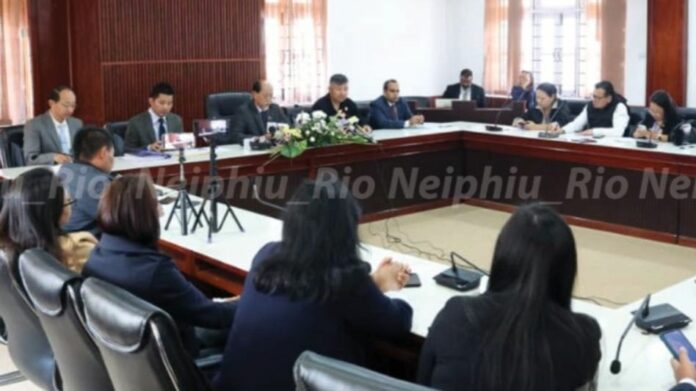
Kohima, March 27: The Nagaland Legislative Assembly on March 27 deferred the Frontier Nagaland Territorial Authority (FNTA) Bill and referred it back to the state government for further examination, following concerns raised by legislators and pending inputs from the Centre.
The Bill, introduced a day earlier by Deputy Chief Minister Yanthungo Patton, was scheduled for discussion and passage. However, Speaker Sharingain Longkumer informed the House of a communication from Parliamentary Affairs Minister KG Kenye highlighting issues flagged by the Eastern Nagaland Legislators Union.
Kenye said a letter from the ENLU pointed to discrepancies between the Bill and the provisions outlined in the Memorandum of Agreement signed on February 5 in New Delhi between the Centre, the state government and the Eastern Nagaland Peoples’ Organisation. He noted that certain key provisions were missing and described the issues as “contentious”, recommending that the legislation should not be passed in the current session.
Chief Minister Neiphiu Rio reiterated the government’s commitment to equitable development of the six eastern districts—Tuensang, Mon, Longleng, Kiphire, Noklak and Shamator—stating that the proposed FNTA is aimed at addressing long-standing socio-economic and administrative aspirations in line with the agreement.
He said the authority was envisaged as a special self-governing body under a four-tier governance structure, with the state allocating funds based on population and area, while the Centre would provide additional development support. The FNTA would also have the mandate to prepare annual plans and prioritise projects.
However, Rio highlighted legal and procedural challenges, noting that the state Cabinet, after legal consultation, found that legislative powers cannot be delegated to such an authority under the existing constitutional framework through a state law.
He further informed the House that the matter has been referred to the Ministry of Home Affairs, which is examining the issue and has sought additional time, including the opinion of the Solicitor General of India.
Rio added that both the ENPO and ENLU had urged the government to defer the Bill until all concerns are addressed and clarity emerges on the agreement’s provisions. He emphasised that, given the request from the Centre and stakeholders, the Bill should be reconsidered to ensure legal and constitutional validity.
Accepting the proposal, the Speaker directed that the Bill be deferred to the next emergent session and formally referred it back to the government for further review and necessary corrections.
