
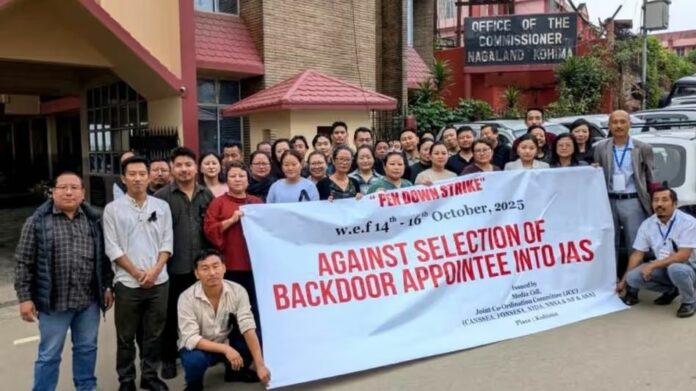
Kohima: A coalition of civil service associations in Nagaland has strongly criticised the state government’s defence for inducting non-State Civil Service (SCS) officers into the Indian Administrative Service (IAS), calling the move constitutionally flawed.
In a statement issued on October 31, the Joint Coordination Committee (JCC)—comprising five major associations, including CANSSEA, FONSESA, NIDA, NSSA, and NF&ASA—rejected the government’s justification and accused it of undermining constitutional principles.
The controversy centres on the inclusion of what the JCC described as “irregularly appointed officers” — individuals who entered government service without going through constitutionally required recruitment procedures — in the IAS induction panel.
While the government spokesperson claimed that the process was “within the constitutional framework” and defended the inclusion of “regularised officers serving with integrity and seniority,” the JCC countered sharply. “How is it within the constitutional framework when the very entry into service of irregularly appointed officers had been in violation of Article 14 and 16 of the Constitution of India?” the committee stated. “Induction into the IAS is not akin to attaining sainthood, where your past sins are forgiven. We are still on Earth where the rule of law prevails.”
Citing the Supreme Court’s landmark 2006 judgment in Uma Devi vs State of Karnataka, the JCC stressed that regularisation cannot legitimise an initially unconstitutional appointment. It also criticised the government’s claim that long-serving officers who demonstrated competence should be eligible for promotion, calling the argument “deeply ironic” as it “defends those who violated Article 16 while pleading for equal opportunity.”
The government had also referenced a Supreme Court judgment from Rajasthan that allowed the inclusion of a non-SCS officer, suggesting a precedent. The JCC dismissed this analogy, clarifying that the Rajasthan case concerned reserved posts for non-SCS officers — a procedural issue — whereas the current case involves fundamentally irregular appointments.
“The Government must not whitewash backdoor appointees and glorify them,” the JCC declared in its concluding remarks.
The statement, released by the JCC’s media cell from Kohima, signals escalating tensions between the state’s career bureaucrats and the administration over what they describe as an erosion of recruitment integrity.
