
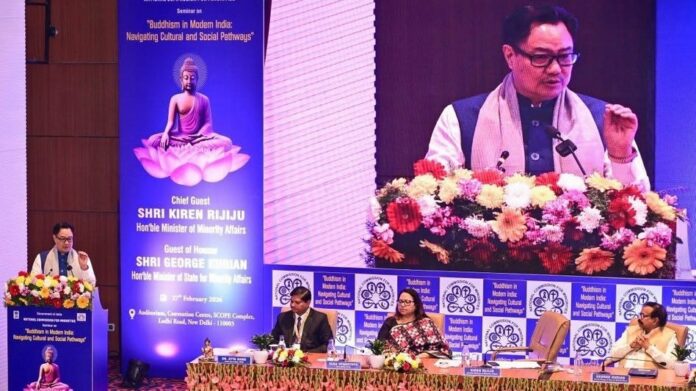
National, Feb 28: The National Commission for Minorities convened a national seminar on February 28 at the SCOPE Complex in New Delhi, focusing on the theme “Buddhism in Modern India: Navigating Cultural and Social Pathways.” The event brought together policymakers, scholars and religious figures to deliberate on the contemporary relevance and future trajectory of Buddhist thought and heritage in India.
Union Minister for Minority Affairs and Parliamentary Affairs Kiren Rijiju attended as the chief guest, while Minister of State for Minority Affairs George Kurian was also present. Among the panelists was Shri Tseten Tashi Bhutia, Chief Advisor of the Bharatiya Janata Party, Sikkim, who addressed participants during the discussion session.
In his remarks, Bhutia underscored the enduring significance of the teachings of Gautama Buddha in shaping contemporary Indian society. He highlighted values such as compassion, peace, mindfulness and the Middle Path as essential principles for fostering social harmony and inclusive development. Emphasising the importance of safeguarding Sikkim’s Buddhist legacy, he called for stronger institutional backing for Buddhist studies and encouraged the youth to stay rooted in India’s spiritual and cultural traditions. He also noted that Buddhist philosophy contributes meaningfully to the broader national vision of Viksit Bharat @2047.
The panel discussion featured a diverse group of scholars and dignitaries, including Shri Niraj Kumar, Joint Secretary in the Ministry of Development of North Eastern Region; Acharya Shri Yeshi Phuntsok, a senior Mahayana Buddhist monk based in Delhi; Ms. Jigme Youdron Lhamo of Druk Drilburi Nunnery in Himachal Pradesh; Shri Mahendra Bante of Bhadant Gyaneshwar Buddha Vihar in Kushinagar; Dr Manish Sinha, former Head of the Department of History at Magadh University in Bodhgaya; and Professor Sanjeev Kumar H.M. from the Department of Political Science at University of Delhi. The speakers examined the cultural, social and academic dimensions of Buddhism in present-day India, reflecting on its evolving role in a rapidly changing society.
During the programme, the Commission felicitated the special invitees in recognition of their contributions. The seminar reiterated India’s historical identity as the land of the Buddha and explored strategies to strengthen Buddhist scholarship, preserve ancient languages and promote the country’s rich Buddhist heritage both nationally and internationally.
