
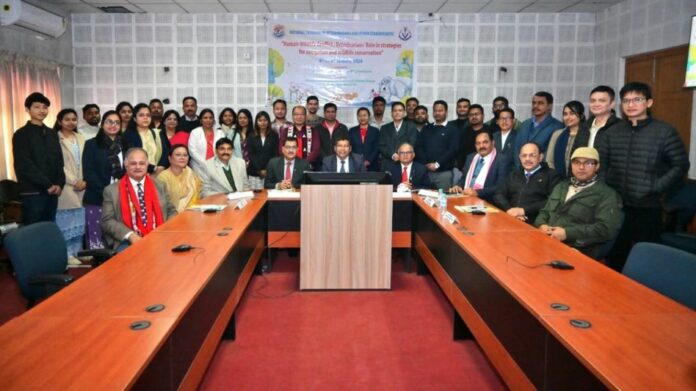
Guwahati, Jan 6: A three-day national-level training programme aimed at strengthening the role of veterinarians in addressing human–wildlife conflict began on January 6 at the College of Veterinary Science in Khanapara, Guwahati. Titled “Human–Wildlife Conflict: Veterinarians’ Role in Strategies for Mitigation and Wildlife Conservation,” the programme will continue until January 8, with a special emphasis on managing human–elephant conflict, a growing concern across several parts of the country.
The initiative seeks to equip veterinary professionals with practical skills, scientific knowledge and strategic approaches to reduce conflict between humans and wildlife while promoting conservation. In her welcome address, course director Dr Munmun Sarma highlighted the objectives of the programme and stressed the critical role veterinarians play in conflict mitigation, wildlife rescue and long-term conservation efforts, particularly in conflict-prone regions.
Addressing the participants, Dean of the College of Veterinary Science Dr Bibekananda Saikia underscored the urgency of adopting coordinated, science-based solutions to manage increasing instances of human–wildlife conflict in the Northeast. Padma Shri awardee Dr Kushal Konwar Sarma, an internationally recognised elephant expert, shared insights drawn from his decades of experience in elephant rescue, rehabilitation and management, offering valuable perspectives on humane and effective conflict mitigation.
The inaugural session was presided over by Dr Niranjan Kalita, Vice-Chancellor of Assam Veterinary and Fishery University. The programme was formally inaugurated in the presence of Dr M K Yadav, Special Chief Secretary to the Government of Assam, who attended as the chief guest. Principal Chief Conservator of Forests (Wildlife) and Chief Wildlife Warden of Assam, Dr Vinay Gupta, and Director of the Animal Husbandry and Veterinary Department, Dr Jayanta Kumar Goswami, were present as guests of honour.
The training curriculum includes modules on human–elephant conflict management, community awareness and participation, the expanding role of veterinarians in conflict situations, and standard protocols for rescue and rehabilitation of elephants. One of the key highlights is a hands-on field training session at Pobitora Wildlife Sanctuary, conducted under the guidance of Dr Kushal Konwar Sarma, providing participants with practical exposure to real-world scenarios.
A total of 30 veterinarians from Assam, Meghalaya, Nagaland, Arunachal Pradesh and Chhattisgarh are taking part in the programme. The training is being conducted with financial support from the Ministry of Environment, Forest and Climate Change, Government of India, reinforcing the emphasis on capacity building and collaborative conservation efforts nationwide.
