
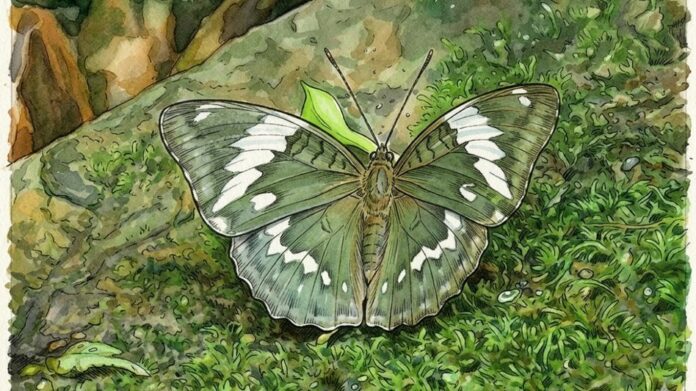
Itanagar, March 29: A newly identified butterfly species discovered in Arunachal Pradesh has been named after Assamese music icon Zubeen Garg, reflecting both the ecological richness of the region and the cultural legacy of the artist.
The species, scientifically classified as Euthalia (Limbusa) zubeengargi, was recorded in the Basar region of Leparada district. The discovery was made by butterfly enthusiast and policeman Roshan Upadhaya along with researcher Kalesh Sadasivan during field studies in the forested terrain.
Researchers later confirmed the butterfly as a previously undocumented species and proposed the common name “Basar Duke,” linking it to its place of origin. The finding is being viewed as a notable scientific development as well as a tribute to Garg’s influence across Northeast India.
Officials said the species appears to be extremely rare, with only two individuals recorded so far despite extensive surveys. This has raised questions about whether the butterfly is inherently scarce or simply difficult to detect within dense forest habitats.
The species inhabits semi-evergreen forests at elevations of 600–700 metres, typically within shaded understories. Observations indicate that it moves slowly through foliage, feeds primarily on tree sap, and derives minerals from moist surfaces.
Morphologically, the butterfly is marked by olive-brown wings with distinct white patterns and a subtle iridescent sheen. Detailed examination of wing structures and anatomical features of male specimens confirmed its classification as a distinct species within the Euthalia genus.
Researchers said naming the species after Zubeen Garg serves as a tribute to his contribution to music and culture in Assam and the wider Northeast. The discovery follows a similar instance where a newly identified plant species was also named in his honour, highlighting a growing trend of recognising regional figures in scientific nomenclature.
Scientists believe such recognitions not only honour cultural icons but also help draw attention to the biodiversity of the Eastern Himalayan region and the importance of its conservation.
