
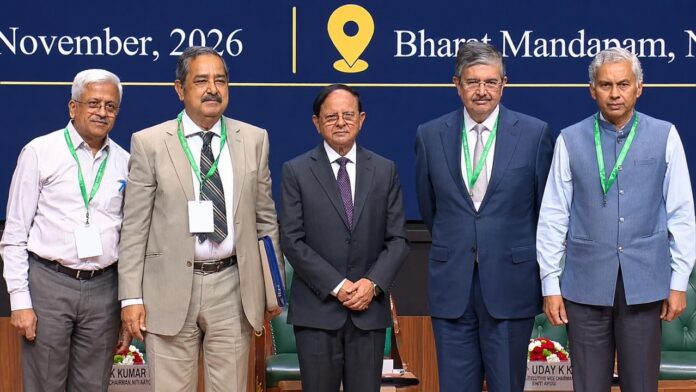
Guwahati, Nov 18: NITI Aayog on Tuesday organised the first in a series of five national workshops aimed at documenting leadership and governance lessons from Prime Minister Narendra Modi’s 25 years in public office, with the findings set to form part of training material for civil servants and educational institutions.
The workshop, titled ‘Leadership as a Mission’, was held at Bharat Mandapam in New Delhi. Dr P K Mishra, Principal Secretary to the Prime Minister, delivered the inaugural keynote address, while senior government officials, academics, business leaders and representatives of community organisations participated in the deliberations.
Modi assumed office as Gujarat Chief Minister in October 2001 and became Prime Minister in May 2014. The workshop series seeks to examine his leadership experience at both state and national levels, focusing on governance principles such as Antyodaya, Jan Bhagidari and Sabka Saath, Sabka Vikas, Sabka Vishwas, Sabka Prayas.
More than 900 people attended the programme, including 250 participants directly involved in the discussions. The gathering brought together Union and state government secretaries and senior officers, district collectors from Aspirational Districts, university students, community partners and beneficiaries of flagship government schemes. The proceedings were also streamed through the iGOT Karmayogi platform and administrative training institutes across the country.
Welcoming the participants, NITI Aayog CEO Anurag Jain said the initiative aimed to convert the lessons of 25 years of leadership into institutional knowledge. He identified four key principles: placing purpose above position, replacing command with service, drawing resilience from conviction, and building institutions and systems capable of sustaining empowerment beyond individual leadership.
NITI Aayog Vice-Chairman Ashok Kumar Lahiri, in his opening remarks, highlighted the importance of political and administrative leadership in India’s development journey. He said the vision of Viksit Bharat by 2047 reflected the country’s ambition to become a developed, prosperous and globally competitive nation.
Lahiri also outlined NITI Aayog’s roadmap for a USD 30-40 trillion economy by 2047, with per capita income projected at USD 15,000-18,000 and sustained annual real GDP growth of 7-10%.
In his keynote address, Mishra cited India’s response to the 2001 Kutch earthquake and the COVID-19 pandemic, the expansion of its global space presence and the Lakhpati Didi initiative as examples of how political will and responsive administration could translate policy vision into action.
Uday Kotak, founder of Kotak Mahindra Bank, spoke about the role of entrepreneurship in economic growth and nation-building. He highlighted the development of financial and entrepreneurial support systems and the expansion of India’s start-up ecosystem.
NITI Aayog Member R Balasubramaniam explained that the workshop followed five stages — Learn, Analyse, Reflect, Apply and Commit — taking participants from first-hand accounts of major policy decisions to discussions on how the lessons could be incorporated into their own leadership practices. He said the initiative sought to develop an Indian body of knowledge on public leadership to strengthen civil services training.
During a session titled ‘Leadership Moments’, four speakers shared experiences from major governance initiatives. Rajeev Topno, Additional Chief Secretary and Principal Secretary of Gujarat’s Health and Family Welfare Department, discussed the reconstruction of Kutch after the 2001 earthquake. He highlighted public participation, institutional capacity, decisive planning and collective resolve as key elements of the rebuilding process.
Former Union Health Secretary and former UPSC Chairperson Preeti Sudan spoke about India’s COVID-19 response, describing its evolution from a whole-of-government effort into a whole-of-society movement. She highlighted the role of technology, the protection of healthcare and frontline workers, public participation through Jan Andolan and the Vaccine Maitri programme, under which India supplied around 300 million vaccine doses to more than 100 countries.
Former Rural Development Secretary Shailesh Kumar Singh discussed the Lakhpati Didi initiative, saying it recognised rural women as entrepreneurs, producers and service providers. He said the programme aimed not only to increase incomes but also to promote economic independence, dignity and recognition for women.
Former ISRO Chairman and former Secretary of the Department of Space S Somanath spoke about the impact of liberalised foreign direct investment norms in opening the space sector to greater private participation. He highlighted ISRO’s role in supporting private players through its expertise, infrastructure and facilities, and referred to India’s Space Vision 2047 as a step towards strengthening the country’s scientific capabilities and global standing.
Participants subsequently took part in a Case Clinic, where groups comprising government officers, community representatives and students examined specific decisions from the four leadership experiences. Case writers trained under the Amrit Gyaan Kosh initiative of the Capacity Building Commission guided the discussions.
The Capacity Building Commission will develop the deliberations and first-hand accounts into case studies for the iGOT Karmayogi platform, making them available to civil servants, training institutes and universities.
A panel discussion on ‘Leadership for Viksit Bharat’ and an Application Clinic for government officers were also scheduled as part of the programme. Cabinet Secretary Dr T V Somanathan was due to launch the Karmayogi Sankalpa and deliver the closing remarks.
The five-workshop series will also generate research and teaching material on policy and administration, with a focus on the development goals set for Viksit Bharat by 2047.
