
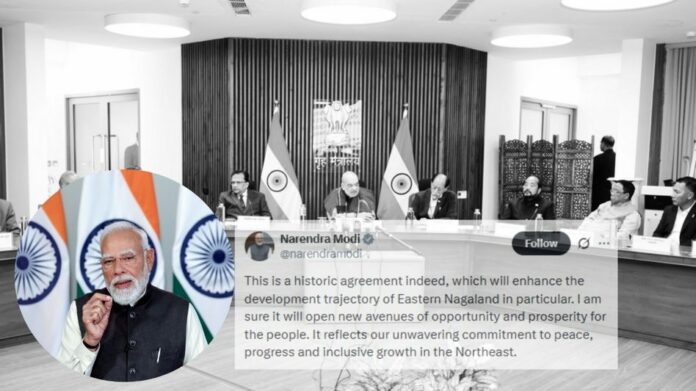
Kohima, Feb 6: Prime Minister Narendra Modi on Friday described the newly signed tripartite agreement on Eastern Nagaland as a historic milestone, saying it would significantly boost development and create new opportunities for people in the region while reinforcing peace and stability in the North East.
The agreement, signed a day earlier by the Centre, the Nagaland government and the Eastern Nagaland Peoples’ Organisation, aims to accelerate development in Eastern Nagaland through a new governance framework. Calling the pact “a historic agreement indeed”, the Prime Minister said it would strengthen the development trajectory of the region and open fresh avenues of prosperity, reflecting the government’s long-term commitment to inclusive growth and stability.
The pact was signed in the presence of Union Home Minister Amit Shah and Nagaland Chief Minister Neiphiu Rio and provides for the establishment of the Frontier Nagaland Territorial Authority. The proposed authority will cover six eastern districts—Tuensang, Mon, Kiphire, Longleng, Noklak and Shamator—and will be empowered to function across 46 subjects, giving the region greater administrative and developmental autonomy.
A major thrust of the agreement is decentralisation of administration. It предусматри the creation of a mini-secretariat for the new authority, to be headed by senior officials of the state government, and introduces a formula for sharing development funds for Eastern Nagaland based on population and geographical area. Officials clarified that the arrangement will not dilute or alter the special constitutional safeguards enjoyed by Nagaland under Article 371(A).
Union Home Minister Amit Shah described the signing of the agreement as a significant moment for a dispute-free North East. He said the pact aligns with the Prime Minister’s vision of ending insurgency, violence and prolonged disputes that had historically hindered the region’s progress. Shah noted that unresolved conflicts and armed movements had once pushed parts of the North East into prolonged instability.
Highlighting the Centre’s approach, Shah said the government has focused on resolving long-standing issues through sustained dialogue. Since 2019, he said, as many as 12 major agreements have been signed in the region. He emphasised that the current strategy goes beyond symbolic accords and prioritises implementation in both letter and spirit.
The Eastern Nagaland agreement is widely viewed as a major structural reform in governance, expected to address decades-old demands for equitable development and greater local decision-making. With enhanced authority and targeted resource allocation, the pact is seen as a key step towards balanced growth and lasting peace in one of the North East’s most sensitive regions.
