
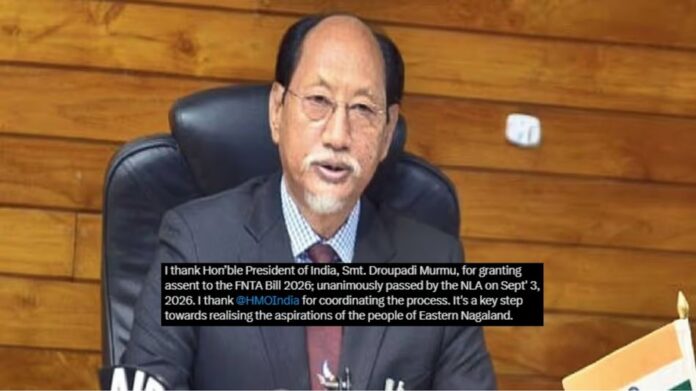
KOHIMA, Oct 26: Nagaland Chief Minister Neiphiu Rio on Sunday welcomed President Droupadi Murmu’s assent to the Frontier Nagaland Territorial Authority (FNTA) Bill, 2026, describing it as a significant step towards fulfilling the aspirations of people in eastern Nagaland.
In a post on X, Rio thanked the President for approving the legislation, which was unanimously passed by the Nagaland Legislative Assembly on September 3. He also acknowledged the Union Ministry of Home Affairs for coordinating the process.
The legislation provides for an autonomous authority covering six eastern districts — Tuensang, Mon, Longleng, Kiphire, Noklak and Shamator — with powers over 46 subjects, including agriculture, health, education, rural development and tourism.
The Assembly passed the revised Bill after withdrawing an earlier version introduced on March 26. Deputy Chief Minister Y Patton introduced the revised legislation on September 1.
The development follows a Memorandum of Agreement signed on February 5, 2026, between the Centre, the Nagaland government and the Eastern Nagaland Peoples’ Organisation (ENPO) after years of negotiations over greater autonomy for the region.
The revised Bill was passed amid discussions over the authority’s proposed powers. Rio had informed the Assembly that the Union Home Ministry wanted the state government to await its views on the proposed conferment of legislative powers. The ENPO had urged the government to honour the agreement, while the Eastern Nagaland Legislators’ Union sought greater clarity before the Bill’s passage.
The FNTA will comprise 62 members, including 40 elected representatives, 20 MLAs from the region as ex-officio members without voting rights, and two members nominated by the Governor. One-third of the elected seats will be reserved for women.
An Executive Council comprising up to nine members and headed by a Chief Executive Member will oversee the authority’s functioning.
The legislation provides for the continuation of constitutional safeguards under Article 371(A), the Bengal Eastern Frontier Regulation of 1873 and exemption from the Panchayati Raj system.
The Act will come into force on a date notified by the state government in the Official Gazette. An interim council of up to 13 members may be constituted until the first elected authority is established. The agreement also provides for a review of the arrangement after 10 years.
