
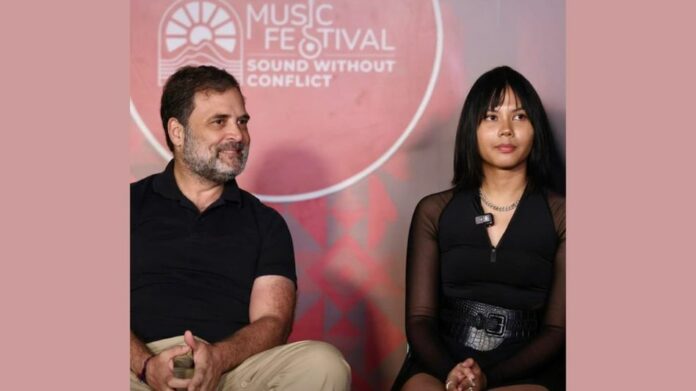
Shillong, Feb 23: When Meghalaya rapper Reble stepped onto the stage at Jawaharlal Nehru Stadium on Sunday evening, she performed before a Delhi audience that had only recently discovered her music — and in the presence of one of India’s most prominent political figures seated just rows away.
The North East Music Festival – Sound Without Conflict made its debut in the national capital on February 22, transforming Gate 17 of the stadium into a showcase of folk, indie, rock and hip-hop rooted in the cultural landscape of northeast India. With free entry, the event drew a substantial crowd, reflecting growing interest in music from the region.
Among those in attendance was Congress leader Rahul Gandhi, who was seen interacting with several artists from the Northeast during the evening. A social media post shared by Gandhi featured a reel cover image of him seated beside Reble. Assam Congress MP Gaurav Gogoi and Manipur MP Bimol Akoijam were also present, underlining the broader significance of the festival beyond its musical performances.
For Reble, the Delhi performance marked another milestone in what has been a transformative year. Born in West Jaintia Hills, she began writing rap lyrics at the age of eleven and gradually built a loyal following across the Northeast. Her breakthrough into the national spotlight came late last year with her work on the soundtrack of the Bollywood espionage thriller Dhurandhar, starring Ranveer Singh. The film emerged as one of the industry’s biggest recent commercial successes.
Reble has described the project as her first meaningful entry into Bollywood, an opportunity that materialised unexpectedly. Her performances on tracks such as “Naal Nachna” and “Run Down The City – Monica” introduced her measured yet impactful delivery to a wider audience. At JLN Stadium, she carried that same distinct energy, holding the crowd with her unhurried flow and grounded stage presence.
The evening’s lineup reflected the diversity of the Northeast’s musical traditions. Rewben Mashangva opened with folk compositions inspired by the Naga hills, while Borkung Hrangkhawl delivered a forceful fusion of rap and rock. The Tetseo Sisters blended contemporary pop-punk with folk influences, and Taba Chake sustained the momentum with a folk-rock set. The night concluded with veteran rock band Parikrama, joined by Rudy Wallang and Girish Pradhan of GATC, culminating in a blues and hard rock finale that capped the festival on a high note.
Built around the idea that the Northeast’s music embodies histories of identity, resilience and community often unheard in mainstream spaces, Sound Without Conflict offered more than performances. An interaction segment allowed artists to share their perspectives, while food stalls and community zones fostered a sense of gathering rather than spectacle. For Reble and her fellow performers, the Delhi debut sent a clear message: music from the Northeast is no longer waiting in the margins — it is ready for centre stage.
