
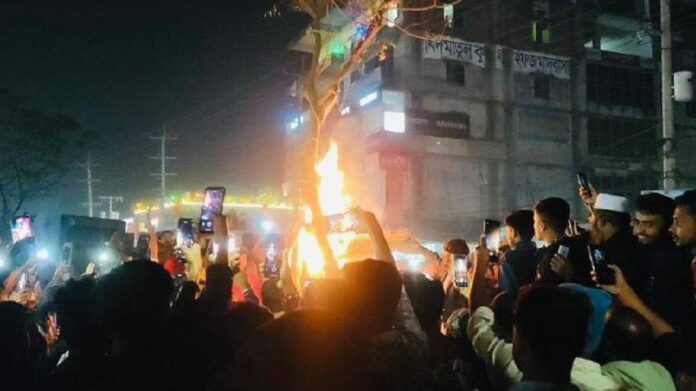
Bangladesh’s interim government on Saturday, December 20 announced the arrest of seven individuals in connection with the lynching and killing of a Hindu man in the Mymensingh district, an incident that has sparked widespread outrage within the country and drawn sharp political reactions from India. The arrests were confirmed by the Chief Adviser to the Government of Bangladesh, who said the Rapid Action Battalion (RAB) carried out coordinated operations to detain the suspects.
According to the official statement, the arrested individuals are Md. Limon Sarkar (19), Md. Tarek Hossain, Md. Manik Mia, Ershad Ali (39), Nijum Uddin (20), Alomgir Hossain and Md. Miraj Hossain Akon. They were taken into custody during raids conducted by RAB-14 at multiple locations. Authorities said the investigation is ongoing and further legal steps will be taken based on evidence and statements collected during interrogation.
The arrests follow the killing of Dipu Chandra Das, a 27-year-old garment factory worker and follower of Sanatan Dharma, who was allegedly attacked by a mob in Valuka in Mymensingh two days earlier. Preliminary accounts suggest the incident occurred around 9 pm after Das was accused of making derogatory remarks about Prophet Muhammad. The mob allegedly assaulted him, tied him to a tree and set his body on fire. Police later reached the spot, dispersed the crowd and recovered the body.
The incident drew strong condemnation from the interim administration led by Nobel laureate Muhammad Yunus. In an official response, the government described the lynching as a serious criminal offence and stressed that mob violence has no place in what it called a “New Bangladesh.” It assured the public that all those responsible would be brought to justice, irrespective of their background or motives.
The killing took place against the backdrop of heightened political tension in Bangladesh following the death of radical political activist Sharif Osman Hadi. Hadi, a candidate for the February 12 general elections, died in a Singapore hospital after suffering gunshot injuries during an attack in Dhaka. He had been shot in the head by masked assailants while launching his election campaign and remained under medical care for six days before succumbing to his injuries.
The lynching also prompted reactions across the border in India, particularly in West Bengal. The state unit of the Bharatiya Janata Party condemned the incident and expressed concern over the safety of Hindu minorities in Bangladesh. In a social media post, the party alleged that the killing reflected a broader pattern of violence against Hindus and drew comparisons with incidents in West Bengal, accusing the Mamata Banerjee-led government of failing to ensure the safety of Hindu communities.
As authorities continue their probe, the killing of Dipu Chandra Das has become a focal point in an already volatile social and political climate. The case has reignited wider debates on religious intolerance, mob justice and the security of minority communities in South Asia, even as Bangladesh’s interim government has reiterated its commitment to swift and transparent legal action to restore public confidence.
