
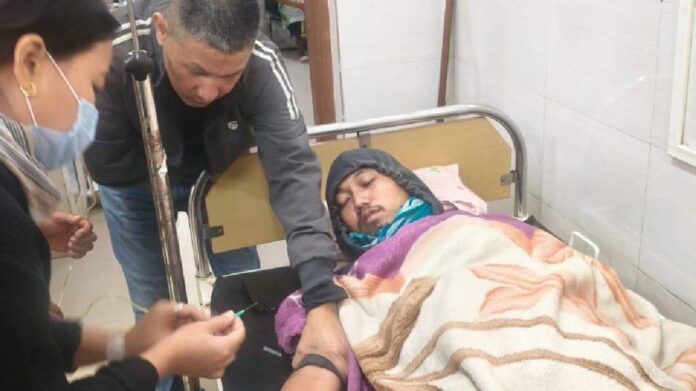
An indefinite hunger strike in Assam’s West Karbi Anglong district entered its seventh day on Tuesday, December 16, escalating pressure on the Karbi Anglong Autonomous Council (KAAC) over alleged illegal occupation of protected government lands. The protest has centred on demands for immediate action against encroachment on Professional Grazing Reserves, Village Grazing Reserves and properties belonging to various state departments.
The agitation is being spearheaded by youth leader and social activist Litsong Rongphar, joined by student representatives and members of civil society, who say the movement reflects a collective struggle to protect indigenous land rights. Although the protest is not being conducted under any formal organisational banner, it has drawn increasing public support, with residents rallying around the call for eviction of encroachers from government-owned land.
Adding moral weight to the protest, traditional customary governors, known as Habe, accompanied by representatives acting under the guidance of the Karbi Customary King, visited the hunger strike site. In a symbolic show of solidarity, they offered water to the protesters and expressed concern over the worsening health of the fasting youths, as slogans demanding eviction echoed across the area.
Protesters have accused the KAAC of failing to honour earlier assurances to remove encroachments, despite repeatedly citing a Supreme Court directive. They referred to a tender issued on October 1, 2024, for the construction of boundary fencing with RCC pillars at the Kheroni Professional Grazing Reserve, a project valued at ₹5.31 crore with a six-month completion timeline. According to the agitators, the work has not progressed, even though commitments were made publicly at a large gathering in Kheroni Chariali last year.
Anger has also been fuelled by the reported decision to keep in abeyance an eviction notice issued on August 25, 2025, which ordered the removal of unauthorised occupants from Irrigation Department land under the Phuloni Revenue Circle. Protesters argue that such delays undermine trust and weaken the protection of indigenous land.
While acknowledging the recent distribution of land pattas to indigenous tribal families as a positive move, the hunger strikers have raised objections over what they describe as constitutional lapses in the process. They allege that pattas were also granted to non-indigenous individuals, including suspected illegal migrants, under the Purthimi Akemang scheme, and have demanded an immediate review of the programme.
The prolonged fast has begun to affect the health of participants, with several women leaders reportedly hospitalised due to gastrointestinal problems. Others continue the hunger strike, stating they will not relent until the KAAC provides a clear, time-bound commitment on eviction measures.
The KAAC has maintained that steps will be taken to address encroachment issues, but the lack of visible action has heightened tension in the district. Security arrangements remain in place as authorities monitor the situation closely.
