
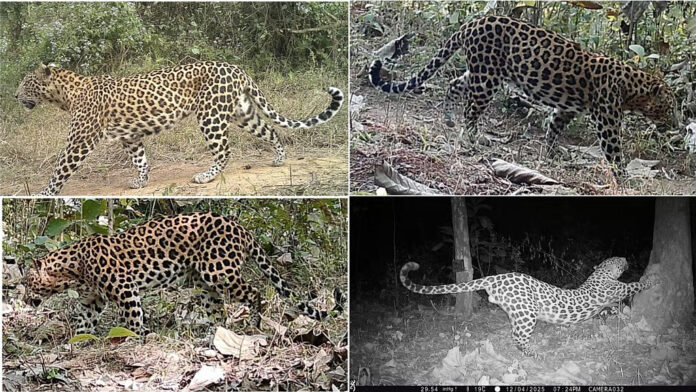
Guwahati: A recent camera-trap study by the Assam Forest Department has revealed that at least 34 leopards inhabit Guwahati, underscoring the city’s significance as an urban wildlife habitat. Conducted under the Assam Project on Forest and Biodiversity Conservation (Phase II), the study was led by Project Director Anurag Singh and implemented by Sunnydeo Choudhary, with key contributions from wildlife biologist Kamal Azad. Using statistical modelling, researchers estimate the actual leopard population in the city could be around 55, suggesting many remain undetected.
The findings show that leopards are not limited to isolated forests but are actively using a network of habitats, including hill forests, wetlands, reserve forests, and even tea gardens. Areas around the Amchang Wildlife Sanctuary have emerged as crucial refuges. Despite their proximity to human settlements, leopards largely remain unseen, with most activity recorded between 10 pm and 2 am. The study highlights their growing adaptation to urban environments, including instances of preying on street dogs—raising concerns about increased human-wildlife interactions.
Also Read: Manoranjan Das Quits Congress After Ticket Denial in Bajali
In addition to leopards, the survey recorded over 25 species, including elephants, clouded leopards, and pangolins, reflecting rich biodiversity within the city. However, rapid urbanisation, encroachment, and habitat fragmentation pose serious threats. The absence of leopard detections in areas like Garbhanga and Rani signals possible habitat degradation. The study emphasises that Guwahati is not just a human settlement but also a thriving leopard landscape, calling for urgent measures to ensure coexistence.
