
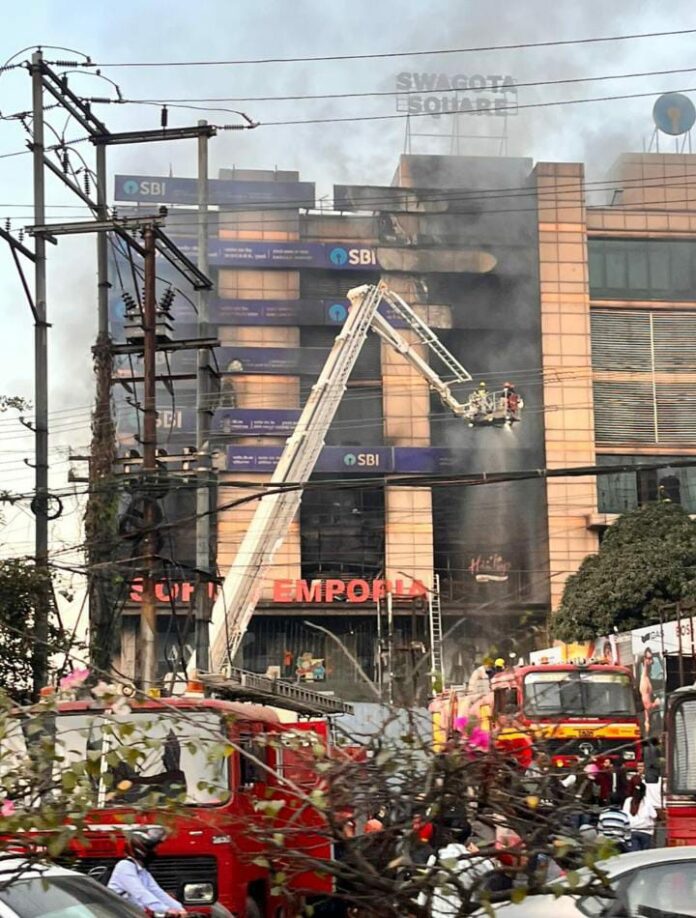
A massive fire at Swagata Square in Guwahati’s ABC locality exposed serious gaps in fire safety compliance across commercial buildings in the city. The blaze, which began late on Tuesday night, continued for more than 33 hours despite large-scale firefighting efforts.
More than 25 fire tenders battled the flames, assisted by water tankers from the Indian Air Force, Indian Army and Guwahati Refinery, while the NDRF deployed a high-tech smoke reduction machine. Additional fire tenders from Morigaon, Kamrup and Nalbari districts joined the operation, with more on the way from Darrang. Thick smoke continued to billow from the upper floors through Wednesday and into Thursday, although no casualties were reported.
According to officials, the fire originated on the second floor, at a godown storing inflammable materials and clothing. The items fuelled the flames rapidly and generated heavy smoke, destroying goods worth crores. The money stored in bank safes inside the building was believed to be secure due to fire-resistant vaults.
Fire & Emergency Services personnel said their teams reached the spot within 15 minutes of receiving the call shortly after midnight and managed to prevent the blaze from spreading further. One firefighter suffered minor injuries and was admitted to Gauhati Medical College and Hospital.
The incident revealed significant shortcomings in the building’s design and preparedness. Fire engines were unable to access the rear side of the structure due to the absence of a proper approach road, forcing crews to work only from the front. Officials and citizens questioned how such a large commercial complex received approval without strict adherence to fire safety norms.
The building’s location in a congested part of the city, close to a busy traffic junction and the Bhangagarh flyover, also hindered firefighting operations, particularly during peak hours. The Assam State Disaster Management Authority said heavy smoke and near-zero visibility inside the building made early intervention impossible.
Authorities secured the surrounding area and evacuated nearby premises as a precaution.
The fire highlighted ongoing concerns over poor enforcement of the National Building Code (NBC) 2016, which mandates smoke detection systems, alarm networks, sprinklers, hydrants, marked exits, fire-rated doors, accessible roads for fire tenders and regular safety audits. Officials noted that many buildings often comply only on paper to obtain clearance certificates.
The incident served as a warning for the Guwahati Municipal Corporation, Assam Fire & Emergency Services and GMDA to conduct urgent fire safety audits, particularly in high-footfall commercial zones such as Ganeshguri, Christian Basti, Fancy Bazar and Maligaon, where safety measures are frequently overlooked. Several older residential buildings also remain vulnerable due to outdated electrical systems.
As Guwahati expands rapidly, especially vertically, the need for strict implementation of building safety standards has become increasingly urgent, officials said.
