
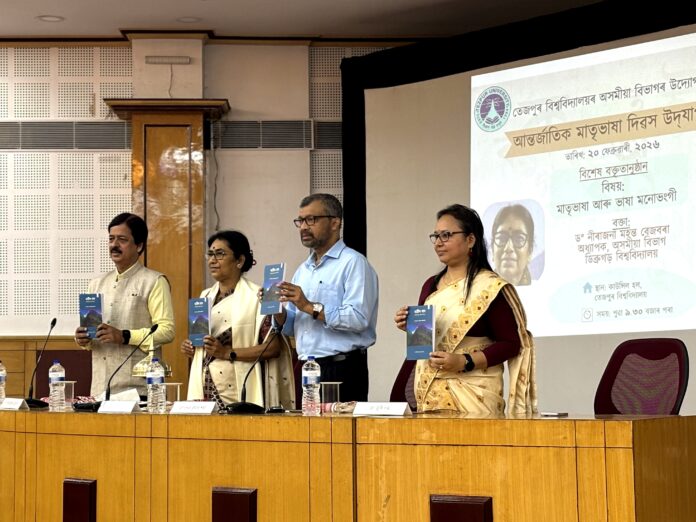
Tezpur: The Department of Assamese, Tezpur University, organized a two-day programme to observe International Mother Language Day from Friday. .Prof. Nirajana Mahanta Bezborah, a noted academician from the Department of Assamese, Dibrugarh University, delivered a special lecture on the topic Mother Tongue and Language Attitude (Matribhaxa aaru Bhaxa Monobhongi)
In her lecture, Prof. Bezborah highlighted that language serves two primary purposes: expressing oneself and understanding others. She cautioned against both linguistic superiority and inferiority complexes — noting that assuming English speakers to be inherently more knowledgeable is problematic, just as believing one’s own language to be inherently superior can be limiting.
She underscored that jaatiya chetana (national consciousness) and jibon chetana (life consciousness) are deeply intertwined with language. Without linguistic self-awareness, the collective strength of a nation weakens. Language, she noted, is not merely a tool of communication but also a means of conditioning, empowerment, and access to progress. While inclusive education is most effective through the mother tongue — a key objective of the United Nations in observing International Mother Language Day — she expressed concern that many languages are not yet fully equipped to deliver education. The shrinking opportunities for future generations to learn in their mother tongues, she remarked, are a serious concern.
Also Read: Priyanka Gandhi Defends Gaurav Gogoi Amid Pakistan Link Allegations by Assam CM
Prof. Dhruba Kumar Bhattacharyya of the Department of Computer Science & Engineering, Tezpur University, spoke on the technological dimensions of language preservation. He explained how supercomputers and artificial intelligence systems are increasingly capable of translating languages; however, he stressed that the existence of comprehensive linguistic repositories and digital depositories is crucial for accurate preservation and translation. Many languages today face the threat of endangerment, and addressing this challenge requires multidisciplinary and multi-institutional research efforts. Technology and language must move together to ensure that no community is left behind.
Prof. Chandan Kumar Sharma, Dean, School of Humanities & Social Sciences, emphasized that all dialects are important and that the social sciences affirm the equal value of all languages. He urged participants to engage deeply with Assamese literary figures such as Lakshminath Bezbaroa and other luminaries to strengthen linguistic and cultural consciousness. In consonance with the event, a book titled Earth Songs: Stories from North-East India (Maatir Gaan-Bharatar Uttar Pubor Chuti Golpa) translated by Dr. Juri Dutta was also released.
