
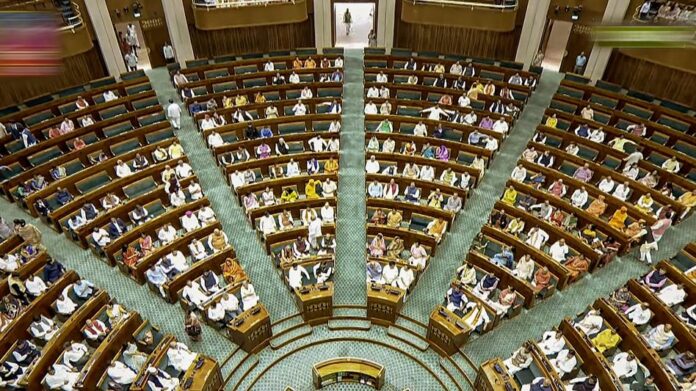
Guwahati, April 19: The Government of India on April 19 released a detailed set of Frequently Asked Questions to clarify its position on women’s reservation in legislatures, days after a Constitution Amendment Bill proposing a 33 per cent quota for women was defeated in the Lok Sabha.
The document sought to counter Opposition claims that the government intended to use the reservation framework to advance delimitation based on the 2011 Census. It outlined that three Bills introduced on April 16 — the Constitution (One Hundred and Thirty-First Amendment) Bill, 2026, the Delimitation Bill, 2026, and the Union Territories Laws (Amendment) Bill, 2026 — were aimed at enabling faster implementation of women’s reservation.
According to the Centre, linking the quota to delimitation based on the post-2026 Census would have significantly delayed its rollout, making it unlikely for women to benefit even by the 2029 general elections. The proposed legislative changes were intended to remove this dependency and allow earlier implementation, potentially ensuring 33 per cent reservation in the Lok Sabha by 2029.
A key element of the proposal involved increasing the strength of the Lok Sabha from the current cap of 550 to 850 seats. The government cited population growth — from 54 crore in 1971 to approximately 140 crore at present — as justification, stating that expansion would improve representation. It added that the increase would follow a uniform 50 per cent model across all states and Union Territories, ensuring that no region would lose its proportional share.
Addressing concerns from southern states regarding delimitation, the government said their representation would not be reduced and could see marginal improvement. It also rejected allegations of political manipulation, stating that no changes were proposed to the Delimitation Commission Act and that any recommendations would continue to require parliamentary approval and Presidential assent. Existing electoral arrangements would remain unchanged until at least 2029.
On social representation, the FAQs noted that Scheduled Castes and Scheduled Tribes would benefit from an increase in reserved seats following expansion of the House. Responding to criticism over the absence of a quota for Muslim women, the government reiterated that the Constitution does not permit reservation based on religion and that existing policies are based on social and economic criteria.
The Centre also dismissed claims linking the proposal to delays in conducting a caste census, stating that a time-bound enumeration process is already underway. It further explained that the Women’s Reservation framework passed in 2023 was intended to establish a legal basis, with implementation dependent on administrative steps such as delimitation.
Separate amendments for Union Territories were proposed to address their distinct legal frameworks, particularly for regions including Jammu and Kashmir, Delhi and Puducherry. The FAQs reflect the government’s effort to advance women’s political representation while responding to concerns over federal balance and electoral processes.
