
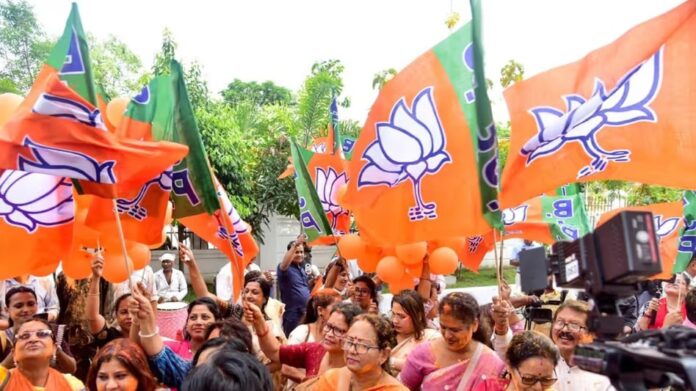
Despite securing a decisive mandate in the 2026 Assam Assembly elections, the Bharatiya Janata Party (BJP) suffered defeats in eight constituencies, highlighting pockets where opposition forces retained strong influence. These losses were concentrated primarily in minority-dominated areas of Barak Valley, central and lower Assam, along with one key constituency in Upper Assam where regional leadership continues to hold sway.
The Indian National Congress emerged as the principal challenger in these segments, winning four of the eight seats. The remaining constituencies were divided among regional and minority-based parties, including the Raijor Dal, All India United Democratic Front (AIUDF), and the All India Trinamool Congress (AITC), underscoring a fragmented yet effective opposition presence.
Several of the defeats were marked by significant margins, pointing to strong consolidation of anti-BJP votes. In Samaguri and Dhing, BJP candidates trailed by over one lakh votes, while Dalgaon recorded the party’s most substantial loss, with a margin exceeding 1.3 lakh votes in favour of the AIUDF. These results indicate deeply entrenched voter preferences in specific regions.
A notable outcome was seen in Sibsagar, where Akhil Gogoi of the Raijor Dal retained his seat, reinforcing his continued grassroots appeal in Upper Assam despite the BJP’s broader statewide dominance. His victory reflects the resilience of regional political forces in select constituencies.
In Barak Valley, the Congress maintained its foothold in Dhubri and Karimganj North, suggesting that the BJP’s expansion in the region still encounters structural challenges. Similarly, constituencies in lower Assam such as Mandia and Birsing Jarua saw wins by AITC and Congress candidates respectively, illustrating how a divided opposition can still effectively counter the ruling party in specific electoral contexts.
Overall, while the BJP has consolidated its position across much of Assam, the election results reveal a clear pattern: constituencies with distinct socio-political dynamics, particularly those with significant minority populations or strong regional leadership, continue to resist its dominance.
