
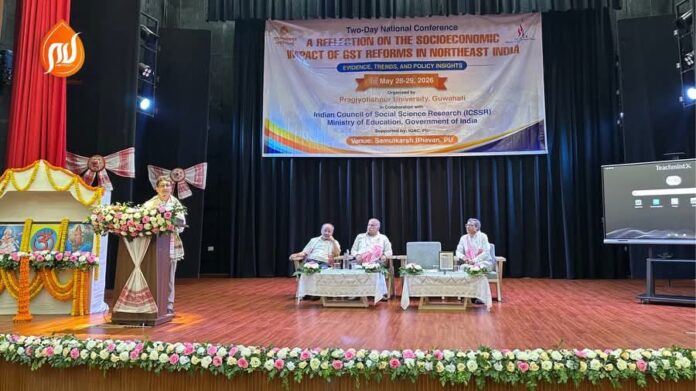
GUWAHATI, May 29: A two-day national seminar examining the impact of the Goods and Services Tax (GST) on the economy and administrative systems of Northeast India began on May 28 at Pragjyotishpur University in Hazangbari, Chandrapur.
The seminar is being organised with support from the Indian Council of Social Science Research and has brought together academicians, researchers and tax experts to discuss various dimensions of GST and its implications for the region.
The inaugural session was held at the university’s Samutkarsha Bhawan auditorium and began with the national anthem and ceremonial lamp lighting. Vice-Chancellor Prof. Smriti Kumar Sinha, in his welcome address, stressed the importance of studying the economic transformation brought about by GST and its effects on the Northeast.
The seminar was formally inaugurated by retired Lieutenant General Rana Pratap Kalita, Chancellor of the university, who described GST as “a key driver of good governance, development, and cooperative federalism”.
Kalita said the Northeast, despite facing geographical challenges and limited market access, had benefited as a consumption-based economy after the implementation of GST. He stated that revenue collection in the region had increased by nearly 27 per cent following the rollout of the tax regime, which could contribute to improved infrastructure and connectivity.
At the same time, he underlined the need for targeted policies to address issues such as digital illiteracy and the difficulties faced by small traders.
Delivering the keynote address, Dr. Prakash Borgohain, Additional Commissioner of Central GST and Customs Department, Northeast Zone, explained the constitutional and practical aspects of GST. He said the new tax structure had simplified the earlier complex taxation system and benefited both taxpayers and administrators.
Dr. Borgohain noted that although the Northeast is not a major industrial region, the consumer-driven nature of the economy has prevented revenue losses under GST. He further stated that tax reductions on products such as tea, bamboo, handicrafts and agricultural goods had helped improve purchasing power among people in the region.
He also referred to the “Karmayogi” initiative under the evolving “GST 3.0” framework, under which training programmes are being conducted to improve awareness and responsiveness among tax officials and citizens.
The inaugural session was anchored by Dr. Jinti Sharma, Assistant Professor in the Department of Commerce and Management and coordinator of the seminar. Registrar Prof. Jogesh Kakati, faculty members, research scholars and invited guests were also present.
The two-day seminar will include four technical sessions featuring discussions and presentations by experts and researchers from institutions across the country.
