
Prakalpa Ranjan Goswami
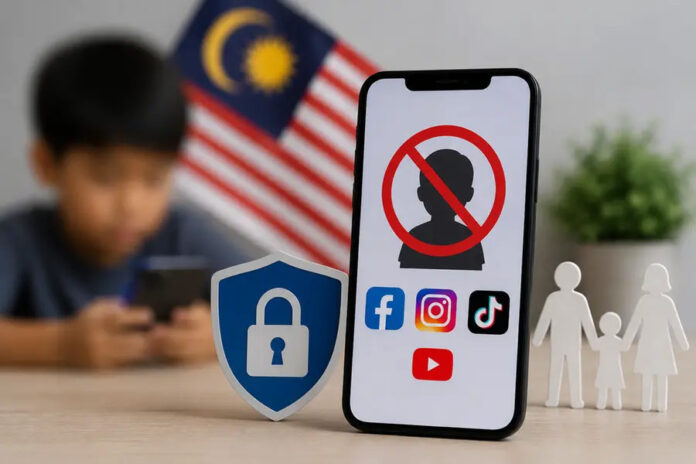
In a significant move aimed at strengthening online safety for young people, Malaysia has begun enforcing new regulations that prohibit children under the age of 16 from creating social media accounts. The policy, which came into effect on Monday, places the Southeast Asian nation among a growing number of countries seeking stricter controls on children’s access to digital platforms. Under the new framework, major social media companies operating in Malaysia must introduce robust age-verification mechanisms to ensure compliance. The regulations apply to platforms with more than eight million users, including widely used services such as Facebook, Instagram, TikTok and YouTube. These companies are now required to prevent users below the age of 16 from opening new accounts. Malaysia’s communications regulator has announced that the verification process for existing users will be introduced gradually over the next six months. Accounts identified as belonging to individuals under 16 will not be immediately removed. Instead, affected users will be provided a one-month window to save, download, or transfer their personal content, including photographs, videos, and other digital materials, before restrictions or account suspensions take effect.
The government has adopted a firm stance on enforcement. Companies that fail to comply with the new rules could face financial penalties of up to 10 million Malaysian ringgit, equivalent to approximately 2.5 million US dollars. However, authorities have clarified that parents will not face punishment if their children manage to circumvent the age restrictions. Officials say the primary objective of the legislation is to protect minors from the growing dangers associated with social media use. These include exposure to harmful or inappropriate content, cyberbullying, online predators, and platform features specifically designed to maximise user engagement and screen time. Authorities argue that children often lack the maturity required to navigate such risks effectively. Malaysia’s initiative reflects a broader international trend. Several countries, including Australia, Brazil, and Indonesia, have already introduced or announced measures limiting social media access for younger users. Meanwhile, governments in Britain, France, Spain, Denmark, Thailand, and South Korea are actively exploring similar regulations as concerns over digital safety continue to grow.
Despite the restrictions, Malaysian authorities insist that the policy is not intended to isolate children from technology. Rather, it seeks to create a safer digital environment while giving parents greater confidence in managing their children’s online activities. Regulators have also directed social media companies to improve safety features, discourage excessive use, and strengthen efforts to detect and remove underage accounts. Technology firms have yet to reveal detailed plans for complying with the new requirements. Some industry representatives have expressed reservations about the policy. Clara Koh, who oversees public policy for Southeast Asia at Meta, previously warned that a blanket ban on under-16 users could produce unintended consequences. According to her, restricting access to regulated platforms may push teenagers toward less secure and unregulated online spaces. Meta has attempted to address child safety concerns through its own initiatives, including special “teen accounts” that provide enhanced privacy protections, screen-time controls, and restrictions on interactions with unknown users. The company argues that such safeguards may be more effective than outright bans. The debate over social media’s influence on young people has intensified worldwide. Governments, educators, and health professionals have increasingly voiced concerns about the potential impact of excessive social media use on mental health, emotional development, and academic performance. These concerns gained further attention in March when a jury in the United States ordered Meta and YouTube to pay substantial damages in a lawsuit alleging that platform design features contributed to harm experienced by a young user.
Many parents in Malaysia have welcomed the government’s intervention. Among them are Kuala Lumpur residents Saravanan Ganasan and Jayaradha Veerasamy, who have long imposed strict controls on their children’s digital habits. Their 12-year-old son and 15-year-old daughter are not allowed unrestricted access to platforms such as TikTok and Instagram. Screen time is closely monitored, devices remain outside bedrooms, and parental supervision is a constant requirement. The couple believes these restrictions have encouraged their children to develop healthier offline interests. Their son spends time reading books and repairing household items, while their daughter enjoys cooking and creative craft activities. They see the new regulations as an extension of values they have already adopted at home.
Nevertheless, critics have raised concerns about the broader implications of the law. Some privacy advocates argue that mandatory age-verification systems may require the collection of sensitive personal information, potentially increasing the risk of data breaches. Others worry that expanded verification requirements could lead to greater government oversight of online activities. As Malaysia embarks on this ambitious experiment in digital regulation, the world will be watching closely. The success or failure of the policy could influence how other nations approach the increasingly complex challenge of balancing children’s online freedom with the need for stronger digital protections.
(The author is a student of Journalism and Mass Communication in Malaysia.)
