
Simona Choudhury
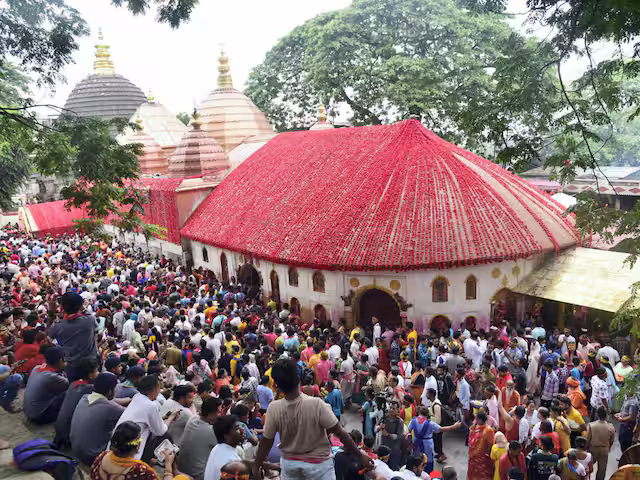
Many moons ago, somewhere between the 7th-9th century, the Kamakhya temple was built in Assam, where the Goddess has been worshipped since time immemorial. Nestled on a hillock with a bird’s eye view of the serene city of Guwahati, the temple faced multiple destruction and was rebuilt by the Koch King Nara Narayan and again by the Ahom kings. As you reach the car parking area, you’ll come across shops on both sides of the street stretched all the way till the temple’s main entrance making it look like a vibrant jamboree, the hustle and bustle exhibits an old world charm, positive vibes and shops run by dedicated Assamese pandit families. After entering through the main entrance, as you take the right towards the administrative block, there’s a “Soubhagya Kund ”, where the devotees wash their feet and hands, offer prayers to the idols of Lord Ganesh before entering the main edifice to seek Goddess Kamakhya’s blessings.
Kamakhya Temple’s distinguished feature is the mythological yoni of Sati, set in natural stone inside a small dark cave below the ground level where there’s a miraculous natural spring of water keeping this stone moist and till date nobody could know the mysterious source of the continuous water flow. There’s Goddess Saraswati and Goddess Lakshmi alongside the yoni. This chamber of the temple is known as “Garbhagriha”.
As I walked through the temple premises, somewhere in-between facts and myths, I had the privilege to gather some information from the Chief Priest Kabindra Sarma, Priests Manoj Sarma and Kamal Sarma regarding the temple’s historical significance. The temple consists of 4 chambers named Chalanta, Garbhagriha, Pancharatna and Natmandira. “Chalanta” is the first portion to the west, a square chamber of Atchala style. The entrance to the temple is generally via its northern door, Ahom style dochala. It houses a movable idol of the Goddess, a later addition, which explains the name.The walls of this chamber contain sculpted images of Nar Narayana, related inscriptions and other Gods. “Chalanta” leads into the “Garbhagriha” via descending steps. The “Pancharatna” to the west of “Chalanta” is large and rectangular with a flat roof and five smaller shikharas of the same style as the main shikhara. The middle shikhara is slightly bigger than the other four in typical “Pancharatna” style. The “Natamandira” extends to the west of the pancharatna with an apsidal end and ridged roof in Ahom style. The inside walls bear inscriptions from the 17th century. The outer wall has stone sculptures from an earlier period.
Once a demon named Naraka fell in love with Goddess Kamakhya and proposed to marry her. To get out of this situation, she gave him a task to build steps from the bottom of Nilachal hill till the temple in one night and promised that on completion of the task she’d marry him. However, when he was about to complete the task, the Goddess played a trick on him. She converted a crow into a cock to give an illusion of dawn. Naraka was tricked easily and stopped making the staircase halfway through. This incomplete steps are called “Mekhelauja Path “. This path still exists but people mostly prefer taking the motor-able road up the hill. Another distinct feature of the temple is the “Rin Muson Kund” which is believed to cleanse your sins. It’s enlightening to know about the existence of a “Sacred Shivling”, “Pimmakeshwar” in the bottom of the pond which remains submerged under the water throughout the year and only once a year the shivling surfaces as the water is pumped out for the devotees to offer their prayers on the auspicious occasion of shivratri. There’s a traditional Bali Ghar where buffalo, goat and pigeon are offered to the Goddess. Right at the entrance, on the left there’s an area where I performed the Kamakhya Hawan. Inside the Chalanta chamber on the left, there’s a small area where the sacrifice( bali) is placed and I performed a special personal puja which even you all can do with prior appointment. Performing the puja and hawan with priests Yuva Kanta Sarma and Kamal Sarma without the constraint of time , as I sat and basked in the blessings of the Goddess, the bells kept chiming in the background. Both the puja and the hawan made it a platform for mental soul and physical regeneration, a beautiful catharsis for me. There’s a bhog ghar which serves khichdi, papad, chole and kheer. Kamakhya temple is one of the 51 Shakti Peetha which is an ancient temple dedicated to the Hindu goddess Parvati. It is also called “Ashta Pitha” and is one of the most significant and powerful pilgrimage destinations for devotees across the globe.
The temple remains closed for three days during Ambubachi festival . The word “Ambu” means water and “Bachi means child . It is believed that Goddess Kamakhya goes through her menstrual cycle during this time, hence the temple remains closed. Lakhs of people throng the holy site around this time to seek penance for their wrong doings and blessings of the Goddess. According to Kalika Puran when Sati’s father King Daksha organized a yagna, he did not invite his daughter and son-in-law Shiva to participate in it. Sati, who was angry at this behavior of her father, went to her father’s place at Kailash to ask the reason for it. Daksha insulted Sati and belittled her husband. Sati could not bear the fact that her husband was being insulted and she immediately jumped into the yagna fire. Knowing this Shiva, became furious and went to Daksha’s palace and chopped off his head . After seeing the corpse of his wife, out of rage he lifted the body of Sati on his shoulder, started the dance of destruction and it continued for several days and the earth was on the brink of being destroyed. To control Shiva and protect the earth, Vishnu chopped off the body of Sati into multiple pieces with his Sudarshan chakra to calm down Shiva.
The body parts of Sati fell all over 51 places in India and Shiva searched for her remains all over the universe. Finally, he found her yoni in Assam’s Nilachal hill where the temple stands high and mighty even today.Hence,it is also known as yonisthana. The Yoni of Devi in the Temple is believed to be very powerful. Tantriks come here to achieve their desired success as Maa Kamakhya is the Goddess of Tantra as well. Kamakhya hillock consist of ten mahavidya. They are Kali, Tara, Sarusi, Bhuvaneshwari, Bhairavi, Chinnamasta , Dhumavati, Bagalamukhi, Matangi, Kamaladevi. I hope the Kamakhya Corridor Project will not ruin the essence of devotion , heritage and the old world charm of the temple surroundings. It is not a tourist spot hence only devotees should be allowed to enter and pray peacefully. (simonachoudhury2009@gmail.com)
