
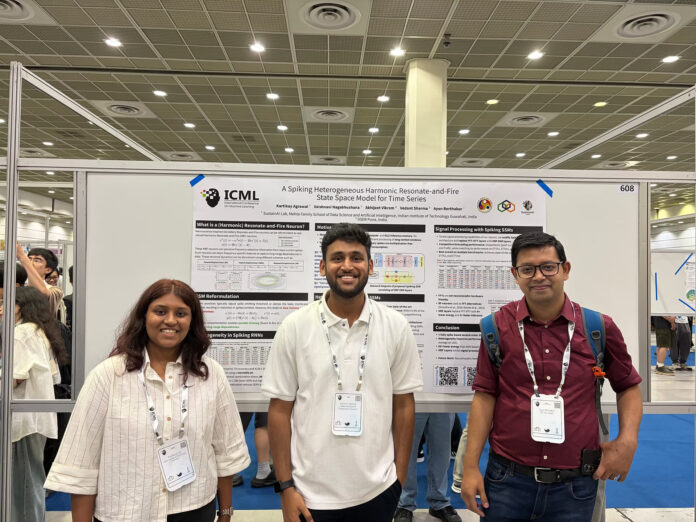
Guwahati : Researchers at the Indian Institute of Technology Guwahati have developed a human brain-inspired artificial intelligence model designed to process long sequences of data efficiently while consuming significantly less energy than conventional AI approaches. The research team from IIT Guwahati’s Mehta Family School of Data Science and Artificial Intelligence presented the work at the International Conference on Machine Learning (ICML) 2026 in Seoul, South Korea. The new model, known as SH²RFSSM, combines spiking neural networks with state-space modelling to handle sequential data. Inspired by the way biological neurons communicate, the system is designed to process information selectively rather than continuously analysing every input.
Also Read: Assam Signs MoUs to Boost AI, Technology in School Education
According to the researchers, the approach was evaluated on 17 benchmark datasets covering areas including long-range sequence classification, regression, human activity recognition and long-term forecasting. The model demonstrated competitive performance against advanced state-space models while requiring substantially lower estimated energy consumption. The researchers said the technology could be particularly useful in situations where computing resources and power are limited. Potential applications include wearable devices, healthcare systems, smart sensors and forecasting technologies.
The development comes amid growing concerns over the energy requirements of modern AI systems. As AI models become increasingly sophisticated and are deployed across a wider range of devices, reducing computational and power demands has emerged as a key research priority. By combining brain-inspired computing with modern sequence-processing techniques, the IIT Guwahati team aims to demonstrate that AI systems can achieve strong performance while operating more efficiently. The research marks another contribution from IIT Guwahati to the development of energy-conscious AI technologies, with potential applications ranging from edge computing to intelligent sensing and real-time data processing.
