
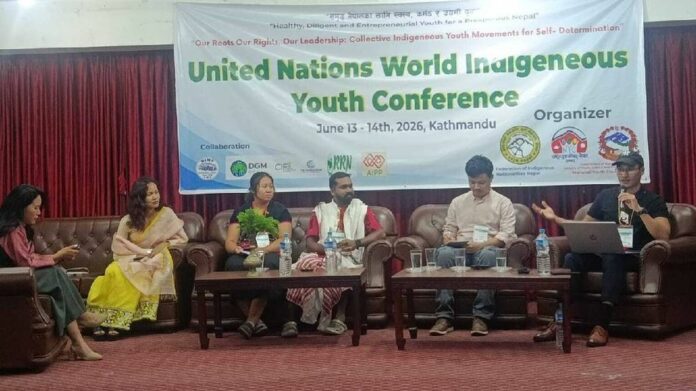
Kohima, June 30: A research scholar from Nagaland University represented India at the United Nations World Indigenous Youth Conference 2026 in Kathmandu, Nepal, where he highlighted the concerns and aspirations of Indigenous youth while contributing to regional discussions on Indigenous rights and leadership.
Repakaba Tzudir, a research scholar from the Department of Sociology at Nagaland University, Lumami, attended the two-day conference on June 13 and 14 as an International Delegate and Indigenous Scholar.
The conference was jointly organised by the Youth Federation of Indigenous Nationalities (YFIN), Nepal, and the National Youth Council (NYC), Nepal under the theme, “Our Roots, Our Rights, Our Leadership: Collective Indigenous Movement for Self-Determination.” Around 150 Indigenous youth leaders, academics, activists and community representatives from different parts of Asia participated in the event.
Representing India alongside delegates from Bangladesh, Myanmar, Nepal and various Indian states, Tzudir also spoke during the panel discussion on “Indigenous Youth Movement in Asia.” In his address, he highlighted the realities faced by Naga youth, pointing to unemployment as a major challenge and explaining how immediate socio-economic concerns often overshadow broader Indigenous issues and long-term aspirations.
Reflecting on the conference, Tzudir said the event demonstrated that Indigenous communities across Asia continue to share similar concerns despite differences in geography and culture. He noted that discussions consistently focused on safeguarding identity, protecting land and culture, and creating meaningful opportunities for young people.
He said one of the key themes of the conference was how Indigenous youth are striving to preserve their traditions while adapting to changing social and economic conditions. According to him, the exchanges reinforced the value of regional solidarity and knowledge-sharing among Indigenous communities.
Tzudir observed that unemployment, migration, limited access to education and livelihood opportunities, along with the gradual decline of Indigenous languages and traditional knowledge, emerged as common challenges across participating countries.
Drawing from the discussions, he remarked that economic issues often take precedence among young people in Nagaland, reducing engagement with broader questions of Indigenous identity and rights.
At the same time, he acknowledged the contribution of Indigenous youth organisations across Asia in promoting leadership, advocacy, cultural revitalisation and community participation. He stressed that economic development and the preservation of Indigenous identity should complement each other, calling for sustainable livelihood opportunities that remain rooted in community values and cultural heritage.
He further emphasised that greater investment in youth leadership, stronger community-driven initiatives and continued regional collaboration would help strengthen Indigenous voices across Asia.
According to Tzudir, participation in the conference enabled Indigenous youth from different countries to build stronger networks and gain a deeper understanding of shared challenges, reinforcing his commitment to research, advocacy and community engagement for Indigenous peoples.
His participation in the conference was supported by the Indigenous Peoples of Asia Solidarity Fund (IPAS Fund) and the Youth Federation of Indigenous Nationalities (YFIN), Nepal, which provided travel and hospitality assistance.
