
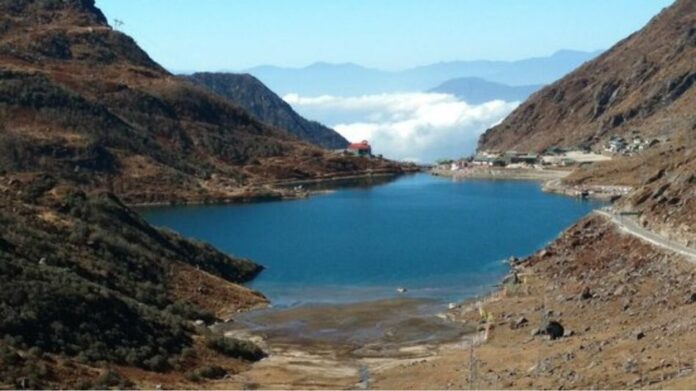
Sikkim has identified 40 glacial lakes as high-hazard sites, with 16 classified as being at the highest risk of a potentially catastrophic glacial lake outburst flood (GLOF), raising concerns over downstream communities and infrastructure.
The assessment came amid growing concern over the rapidly changing Himalayan landscape. A flash flood near the Nepal-Tibet border on August 26, triggered by a glacial collapse, killed hundreds and left several people missing. Although the incident was not classified as a GLOF, it highlighted the risks associated with retreating glaciers and expanding glacial lakes.
Sikkim experienced a major GLOF in October 2023, when at least 60 people were killed and extensive damage was reported across Mangan, Gangtok, Pakyong and Namchi districts. The disaster also destroyed the Chungthang dam, a key component of a major hydropower project.
At a media sensitisation workshop on GLOF risk mitigation on Thursday, Sikkim Principal Secretary Sandeep Tambe said satellite imagery and remote sensing were being used to monitor changes in glacial lakes.
Of the 40 high-hazard lakes, 16 fall under Category A, denoting the highest risk. Two are in Category B, classified as high risk, while nine are in Category C, indicating moderate to low risk. The remaining 13 are yet to be classified.
Tambe said the state was developing lake-specific mitigation plans instead of adopting a uniform strategy. Separate proposals have been prepared for the Lhonak Complex, Shako Chho Lake and the Gurudongmar Complex based on their individual risk profiles.
Shako Chho has been identified by the state government as the lake most vulnerable to a GLOF. Its Detailed Project Report has been submitted to the National Disaster Management Authority, while a preliminary project report has been sent to the Ministry of Jal Shakti.
At the Lhonak Complex, the Central Water Commission and the state government are preparing a DPR for a flood-retention structure at Dolma Sampa near Muguthang. For the Gurudongmar Complex, authorities have proposed a moraine plug wall at the lake outlet, with the Department of Science and Technology and the Brahmaputra Board jointly examining the proposal.
The Department of Science and Technology was designated the nodal agency for GLOF hazard assessment and mitigation studies in February 2025. The work includes water-level and discharge monitoring, geophysical surveys, bathymetry, flood modelling and hazard assessment involving experts from multiple disciplines.
Authorities are also examining measures to lower lake levels, including siphoning, pumping, improving drainage channels, creating artificial channels, cutting through moraines with protective walls and constructing tunnels.
Science and Technology principal director-cum-secretary D G Shrestha said the scale of the 2023 disaster had highlighted the need to strengthen preparedness and institutional capacity. He said Sikkim was working on a dedicated GLOF Risk Mitigation Protocol that could establish a standard scientific framework for assessing and managing glacial flood risks and potentially be adopted by other Himalayan states.
The proposed framework covers preliminary and detailed assessments, design of mitigation measures and their implementation. The state is also considering a broader institutional framework, including a possible commission on glacial hazards, while seeking to address gaps in technical expertise and clarify responsibilities among departments.
Additional early-warning sensors have also been proposed across Sikkim. Shrestha said the proposal received a positive response from Union Home Secretary Govind Mohan during a recent virtual meeting.
Mohan separately reviewed the preparedness of Himalayan states and Union territories for GLOFs and snow avalanches on Thursday. Senior officials from Uttarakhand, Himachal Pradesh, Sikkim, Arunachal Pradesh and Jammu and Kashmir, along with officials from the Ministry of Home Affairs, National Disaster Management Authority, Central Water Commission, India Meteorological Department and Defence Geoinformatics Research Establishment, attended the meeting.
Officials at the workshop also stressed the role of the media in accurately communicating GLOF risks and strengthening public awareness as Sikkim expands its scientific monitoring and mitigation efforts.
