
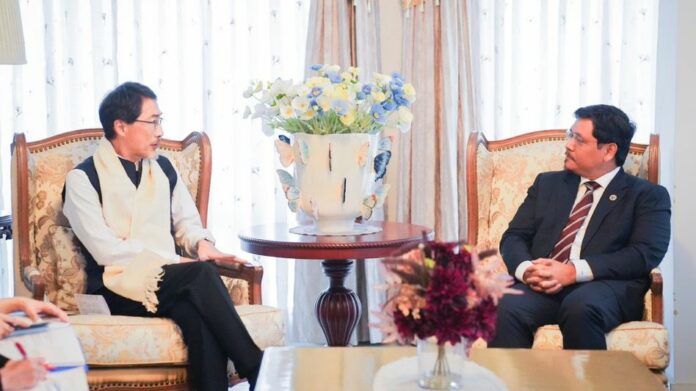
Shillong, Feb 27: Meghalaya Chief Minister Conrad K. Sangma has underscored the evolving strategic partnership between the state and Japan, emphasizing that their collaboration now extends far beyond traditional infrastructure to prioritize youth empowerment, agriculture, and sustainable livelihoods. Speaking at the inaugural session of the sixth India–Japan Intellectual Conclave, themed ‘Kizuna’—a term representing lasting bonds—Sangma highlighted that the relationship is firmly rooted in mutual respect and shared democratic values. He noted that the state’s engagement with Japan is increasingly focused on investing in human capital, marking a shift toward people-centric development that complements physical asset building.
The Chief Minister detailed significant progress in international labor mobility, revealing that 47 nurses from Meghalaya have already been placed in Japan. Following a high-level visit in April 2025, the state formalized an agreement with a Japanese firm to train and relocate 500 youth this year alone, with an ambitious target of 5,000 placements over the next five years. To support this workforce transition, the government has established a dedicated Japanese language training center in Shillong. This initiative aims to equip local aspirants with the necessary linguistic proficiency to succeed in the Japanese job market, effectively bridging the gap between Meghalaya’s youthful demographic—where 74 percent of the population is under the age of 35—and Japan’s technological requirements through a proposed “Meghalaya–Japan Skill Corridor.”
In the agricultural sector, the partnership has yielded the first commercial production of shiitake mushroom blocks in India, located in Upper Shillong. Supported by Japanese technology and marketing expertise, this facility is capable of producing 1.5 lakh inoculated blocks annually, a move expected to benefit over 1,000 local farmers. Furthermore, the state is exploring the production of locally brewed sake by utilizing indigenous rice varieties in collaboration with a Japanese brewery. These ventures represent a broader effort to integrate Japanese precision with Meghalaya’s natural resources to create high-value sustainable industries.
The Japan International Cooperation Agency (JICA) remains a cornerstone of this bilateral relationship, providing critical funding for large-scale infrastructure and environmental projects. Sangma pointed to the restoration of 22,500 hectares of forest across 11 districts under the JICA-supported MegLIFE project, alongside major energy and connectivity works. These include the renovation of the Umiam Hydro Power Station and the funding of the nearly 19-km river bridge connecting Dhubri in Assam to Phulwari. Beyond economics, the Chief Minister noted that cultural ties are flourishing, as seen in the dedicated Japanese pavilion at the Shillong Cherry Blossom Festival, which showcases Japanese cuisine and traditions to local audiences.
Concluding his address to an audience that included Japanese officials and representatives from the Ministry of External Affairs, Sangma invited further engagement from Japanese businesses and academic institutions. He identified climate resilience, the circular economy, and sustainable tourism as priority areas for future cooperation. The conclave serves as a testament to the deepening ties between the Northeast region and Japan, seeking to transform shared history into a future of integrated economic and technological growth.
