
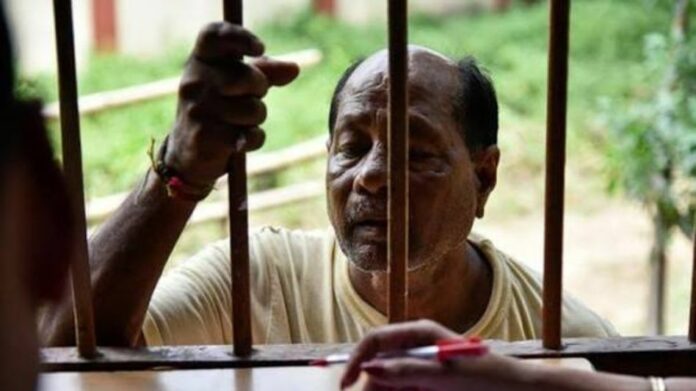
Guwahati, July 2: The Gauhati High Court has affirmed the decision of a Foreigners Tribunal declaring an Assam resident a foreigner, holding that the petitioner failed to legally establish his Indian citizenship despite producing multiple documents and oral evidence in support of his claim.
A Division Bench comprising Justices Kalyan Rai Surana and Shamima Jahan dismissed the petition filed by the daily wage labourer, observing that the evidence presented did not satisfy the legal requirements for proving citizenship. The court ruled that the petitioner had not discharged the burden of proof cast upon him under Section 9 of the Foreigners Act, 1946.
The petitioner, born in 1988 and residing in rented accommodation near Guwahati, had relied on 15 documents to support his case. These included copies of the 1951 National Register of Citizens (NRC) containing the names of his father and grandparents, electoral rolls from different years, a land deed executed by his grandfather in 1973, a school certificate, a PAN card and an Elector’s Photo Identity Card (EPIC). His father also appeared before the Tribunal to testify regarding the family’s lineage.
However, the High Court agreed with the Tribunal’s conclusion that the documents did not establish a legally admissible connection between the petitioner and the ancestors he claimed.
The court specifically rejected the 1951 NRC extract, noting that it was produced only as a computer-generated copy without the certification required under Section 65B of the Indian Evidence Act, now replaced by Section 63(4) of the Bharatiya Sakshya Adhiniyam, 2023. It further observed that Census records, including the 1951 NRC, are not admissible as evidence in view of Section 15 of the Census Act, 1948.
The school certificate issued in 2017 was also found unacceptable because neither the headmaster who signed the certificate nor the school’s admission register was produced to verify its authenticity.
The Bench also pointed out inconsistencies in the electoral rolls submitted by the petitioner. It held that oral testimony by itself cannot establish citizenship in the absence of supporting documentary evidence. During cross-examination, the petitioner’s father was found to be different from the individual whose name appeared in one of the voter lists relied upon in the case.
Concluding that there was no legal error in the Tribunal’s appreciation of the evidence, the High Court dismissed the writ petition and upheld the Foreigners Tribunal’s order declaring the petitioner a foreigner.
