
Meghalaya has emerged as one of India’s highest-performing states in terms of school enrolment but continues to struggle with poor learning outcomes, limited digital infrastructure and a large number of single-teacher schools, according to a new report released by NITI Aayog.
The report, School Education System in India: Temporal Analysis and Policy Roadmap for Quality Enhancement, highlighted that Meghalaya recorded a Gross Enrolment Ratio (GER) of 115.6 per cent at the upper primary level in 2024-25, placing it among the top states in the country. The state’s GER has improved steadily from 98.59 per cent in 2014-15.
Despite the strong enrolment figures, the report found that student learning levels remain significantly below the national average. According to PARAKH 2024 assessments, Grade 3 students in Meghalaya scored 58 per cent in language and 53 per cent in mathematics, compared to national averages of 64 per cent and 60 per cent respectively.
Learning gaps were found to widen further by Grade 9, where students scored 47 per cent in language, 29 per cent in mathematics, 33 per cent in science and 34 per cent in social science, all below the corresponding national averages of 54 per cent, 37 per cent, 40 per cent and 40 per cent. The report observed that foundational learning deficits continue into higher classes, indicating persistent weaknesses in the education system.
The report also identified major infrastructure shortcomings. Only 4.3 per cent of schools in Meghalaya have functional smart classrooms, the lowest coverage in the country. Although this represents a slight increase from 2.3 per cent in recent years, the state remains far behind several others that have rapidly expanded digital classroom facilities.
Accessibility for children with special needs also remains limited. Only 32.8 per cent of schools in Meghalaya have ramps, making it the second-lowest among Indian states after Arunachal Pradesh.
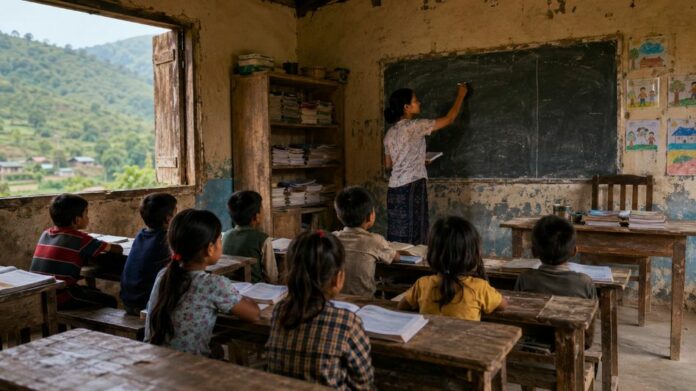
Teacher deployment emerged as another major concern. Meghalaya has 1,414 single-teacher schools catering to nearly 49,807 students. The report noted that teachers in such schools are required to manage multiple classes while simultaneously handling administrative responsibilities, affecting the quality of classroom instruction.
In addition, the state has 74 schools with zero enrolment despite 152 teachers being posted there, indicating inefficiencies in resource allocation. However, the report pointed out that Meghalaya has virtually no teacher vacancies in government schools, suggesting that deployment rather than recruitment requires attention.
Across the Northeast, the report showed varying learning outcomes. While several neighbouring states recorded better scores in language, mathematics, science and social science, Meghalaya registered the lowest mathematics score in the region at the middle-school level.
The report recommended consolidating under-enrolled schools, reducing the number of single-teacher institutions, improving digital infrastructure, strengthening foundational literacy and numeracy, rationalising teacher deployment, and expanding integrated school complexes to improve the overall quality of education.
