
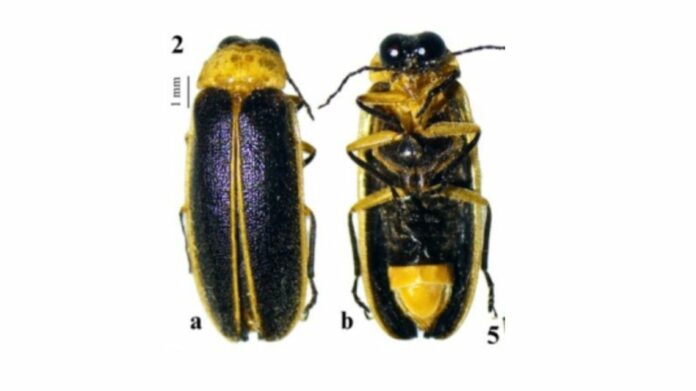
Researchers from Assam Don Bosco University and Debraj Roy College (Autonomous), Golaghat, have discovered a new species of firefly in Mawsynram, the world’s wettest place, naming it Pygoluciola mawsynram in honour of the region’s exceptional biodiversity and the Khasi community’s long-standing conservation traditions.
The discovery was made by researchers Emma Magdalene Nonglang, Dhiraj Kumar Das, Samrat Sengupta and Jane Wanry Shangpliang and has been published in the Asian Journal of Conservation Biology. The finding adds a new member to the rare Pygoluciola genus, increasing the number of recognised species worldwide from 28 to 29 and raising the number of Indian species in the genus to five.
The new species was recorded during field surveys carried out in May 2024 across Mawsynram in Meghalaya’s East Khasi Hills district. Over a period of 10 days, the research team surveyed grasslands, scrublands and semi-evergreen forests, collecting specimens from habitats near streams, waterfalls and hanging vegetation. The firefly was found at only 10 of the 29 surveyed sites, indicating that its distribution may be highly restricted.
The researchers said the species was named after Mawsynram because it was first discovered there and to acknowledge the Khasi community’s traditional practices of protecting sacred groves, forests and other natural landscapes. According to the study, these indigenous conservation efforts have played an important role in preserving the area’s biodiversity.
Detailed morphological studies and DNA-based phylogenetic analysis confirmed that Pygoluciola mawsynram is distinct from all previously identified species. Although it belongs to Group 5 of the Pygoluciola genus, the researchers found that it represents a separate evolutionary lineage with unique anatomical features.
The study also highlighted the ecological significance of Mawsynram, noting that adult fireflies were observed near water bodies surrounded by dense vegetation, ferns and semi-evergreen forests. The researchers suggested that the region’s high humidity and abundant leaf litter are likely essential for the species’ survival and life cycle.
The authors said the discovery demonstrates how much of India’s firefly diversity remains undocumented and emphasised that further field surveys across Northeast India could reveal additional unknown species while improving scientific understanding of the region’s rich insect fauna.
