
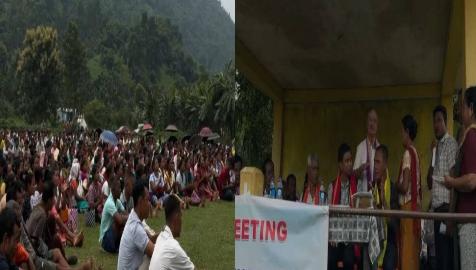
GUWAHATI, Oct 10: Three traditional Khasi chiefs from Meghalaya have vowed not to issue no-objection certificates (NOCs) for the proposed Kulsi Multipurpose Project, as more than 2,000 people from indigenous Rabha, Bodo, Garo and Khasi communities gathered near the Assam-Meghalaya border to oppose the dam.
The rally was held at Kyrshai playground near Ukiam in Meghalaya and organised by the Assam-Meghalaya Joint Protection Committee, formed in 2025 to coordinate opposition to the project. Participants raised concerns over displacement, environmental damage, traditional land rights and livelihoods across the two states.
The three chiefs who attended were Kestor Manik Syiem Iich, Syiem of Hima Nongkhlaw; Phlowing Syiem Nongbak, Syiem of Hima Nongmynsaw; and Order Syiem Sad, Syiem of Hima Rambrai. They assured the gathering that they would not support the proposed dam and would stand with communities opposing it.
Speaking to the media, Nongkhlaw Syiem Kestor Manik Iich said projects involving land in Meghalaya required the consent of the relevant traditional authorities, including the concerned Syiem and village headmen. He said no NOC had been issued for the proposed dam and confirmed that the required consent would not be granted.
The chiefs of Nongmynsaw and Rambrai also said they had withheld their NOCs. They appealed to communities in Assam and Meghalaya to remain united, describing the two states as “two brothers”, and urged residents not to compromise their interests in exchange for agreements or inducements linked to the project.
Albert Nonglang, president of the Assam-Meghalaya Joint Protection Committee, said the dam could affect around 46 villages across the two states. He argued that monetary compensation would not adequately address the long-term consequences of displacement for indigenous communities.
Nonglang said the proposed 62-metre-high dam could have significant ecological and social implications for Assam’s Kamrup district and Meghalaya’s West Khasi Hills district.
Biswajit Rabha, president of the Assam-Meghalaya Youth Joint Protection Committee, highlighted the constitutional protections applicable to tribal areas in Meghalaya under the Sixth Schedule. He stressed the need to secure the consent of local communities and traditional institutions before proceeding with the project.
The rally brought together residents from villages along the Kulsi river basin, where concerns over the proposed project have prompted joint mobilisation across the inter-state boundary. The protection committee maintained that the project’s implications extended beyond infrastructure development to land ownership, livelihoods, traditional institutions and the social fabric of affected communities.
The proposed project on the Kulsi river envisages 55 MW of hydropower generation, irrigation benefits for around 26,000 hectares and incidental flood-management benefits, according to the Union Ministry of Jal Shakti.
The detailed project report estimated the project cost at approximately Rs 1,454.95 crore at June 2017 price levels. The Brahmaputra Board handed over the report and related records to the Assam Power Generation Corporation Limited on July 30, 2026, marking a step towards advancing the project.
The three chiefs’ stated refusal to issue NOCs marks a significant development in the continuing opposition to the proposed dam among communities along the Assam-Meghalaya border.
