
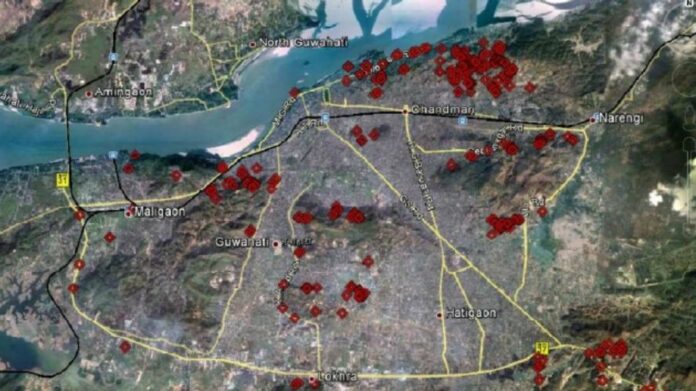
A comprehensive survey of 366 landslide-vulnerable locations across Guwahati has found that human activities are responsible for the vast majority of slope failures, underscoring the increasing impact of unplanned urbanisation on the city’s fragile hill landscape.
The assessment covered 20 areas of the city, including Fatasil, Garbhanga, Gotanagar, Hengerabari, Jalukbari-Lankeswar, Kahilipara, Kalapahar, Kamakhya-Nilachal, Khanapara, Kharguli, Koinadhora, Maligaon, Nabagraha, Narakasur, Narengi, Noonmati, Santipur, Sarania, Sukreswar and Sunsali. Among these, Kharguli recorded the highest number of vulnerable sites at 77, followed by Noonmati with 40, Narengi with 37, Khanapara with 33, Maligaon with 31 and Jalukbari-Lankeswar with 30.
According to the findings, 95 per cent of the identified landslide-prone locations are linked to man-made factors, while only 5 per cent are caused by natural processes. The report attributed the growing instability to activities such as hill cutting, construction on steep slopes, inadequate drainage systems and unchecked urban expansion.
The study found that 88 per cent of vulnerable slopes have an inclination of up to 60 degrees, while 7 per cent have inclinations exceeding 60 degrees. Another 5 per cent were classified as negative slopes. In terms of height, 57 per cent of the identified slopes measure less than five metres, 20 per cent range between five and ten metres, 18 per cent are between 11 and 15 metres, and 5 per cent exceed 15 metres.
Vegetation analysis revealed that nearly 45 per cent of the vulnerable slopes have no vegetation cover, increasing their susceptibility to erosion and failure. Around 36 per cent are covered with grass and bushes, while only 19 per cent have tree cover, which generally contributes to greater slope stability.
The geological composition of the slopes also varied. About 62 per cent consist of a combination of rock and soil, 34 per cent are made up entirely of soil, and only 4 per cent are composed solely of rock.
The report highlighted that 74 per cent of the surveyed locations require immediate intervention to minimise the risk to human lives and property, while the remaining 26 per cent require comparatively less urgent attention.
To aid monitoring and future planning, all identified sites have been mapped and overlaid on Google Earth, providing authorities with a detailed visual representation of landslide hazard zones across the city. The mapping is expected to support disaster preparedness, mitigation strategies and urban planning initiatives.
The findings underline the urgent need for stricter regulation of hill cutting, improved drainage infrastructure, afforestation efforts and scientific land-use planning to reduce landslide risks in Assam’s largest city and safeguard its vulnerable hill ecosystem.
