
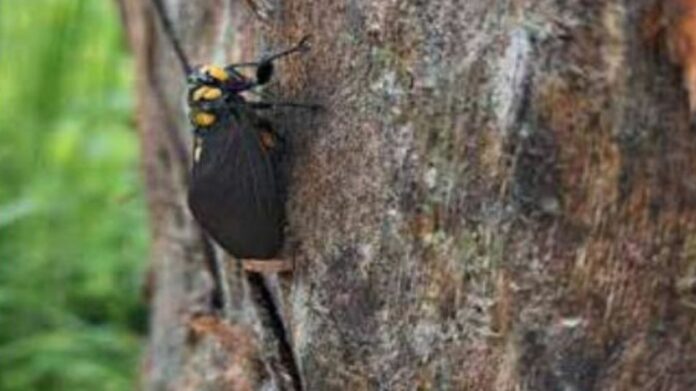
Assam’s Manas National Park has added a rare insect to India’s biodiversity records after researchers documented the black-and-golden cicada Huechys fusca in the country for the first time.
The discovery was made by researchers from Aaranyak and the Durrell Wildlife Conservation Trust during a field survey in the Bansbari range of Manas on May 20, 2024.
The cicada was observed perched on the trunk of an Okshi tree (Dillenia pentagyna) near the Bangale Hat-Dhuwa forest camp. Although it remained visible for only about a minute before flying away, researchers were able to identify the insect as Huechys fusca Distant, 1892.
The first Indian record was documented by Koushik Rajbongshi, Jonmani Kalita and Karan Barman of Aaranyak’s Threatened Species Recovery Programme, along with Dhritiman Das of the Pygmy Hog Conservation Programme, Durrell Wildlife Conservation Trust.
The findings have been published in the July 2026 issue of Zoo’s Print.
Previously reported from parts of Southeast Asia, including Sumatra, the Malay Peninsula, Singapore and Borneo, Huechys fusca had not been recorded in India. Its discovery in Manas therefore expands the known geographical range of the species and adds a new species to the country’s cicada fauna.
Researchers said the finding highlights the rich and relatively unexplored insect diversity of Manas, a protected landscape better known for larger wildlife such as tigers, rhinos and elephants.
The discovery also underscores the importance of continued scientific surveys and habitat conservation, particularly for lesser-known species that contribute to the functioning of forest ecosystems.
Researchers said the latest record demonstrates the potential of Assam’s forests to yield further scientific and ecological discoveries and reinforces the state’s importance as a biodiversity hotspot.
The addition of Huechys fusca to India’s fauna also suggests that Manas could still harbour other species yet to be scientifically documented.
