
Himadri Thakuria
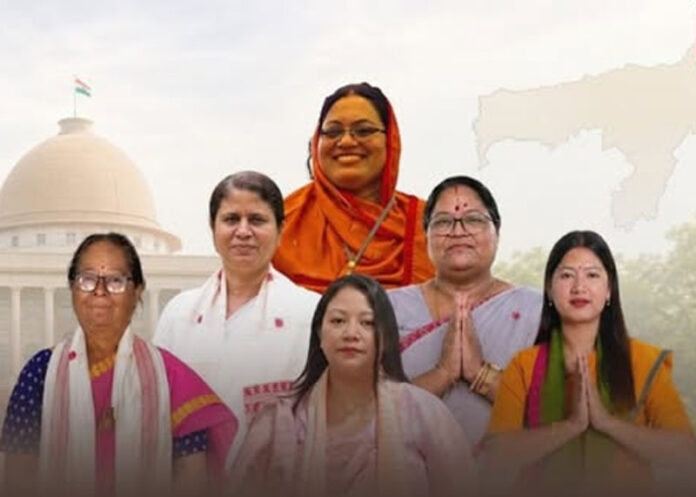
The composition of the sixteenth Assam Legislative Assembly has once again brought into focus a persistent concern in the state’s democratic journey—the underrepresentation of women in politics. Despite significant progress made by women in education, administration, entrepreneurship, sports, and social leadership, their presence in the highest law-making body of the state remains strikingly low. The newly elected Assembly has only seven women legislators in a House of 126 members, accounting for about 5.5 per cent of the total strength. Although this marks a slight increase from the six women elected in 2021, it remains far below expectations in a society where women constitute nearly half the population. The fact that 60 women contested the 2026 Assembly elections demonstrates growing political participation, yet the electoral outcome highlights the challenges women continue to face in securing representation. A closer look at the new Assembly reveals some encouraging aspects. Five of the seven women MLAs are first-time legislators, indicating the emergence of a new generation of female political leaders. The representation of tribal communities is particularly noteworthy, with three women legislators belonging to indigenous tribal groups. The inclusion of a representative from a religious minority community further adds to the diversity of voices in the House.
Historically, Assam has struggled to ensure adequate representation of women in politics. The first Assembly elected in 1952 had only one woman member. The highest number of women legislators was recorded in the twelfth Assembly (2011-2016), when 14 women were elected, accounting for around 11 per cent of the House. More than a decade later, the state has not been able to surpass that benchmark. The issue extends beyond electoral statistics. Greater representation of women is closely linked to more inclusive policymaking. Across India and the world, studies have shown that women legislators often place greater emphasis on healthcare, education, nutrition, sanitation, child welfare, social security, and gender justice. Their participation broadens policy discussions and ensures that governance reflects the experiences and concerns of a wider section of society. Recent developments at the national level offer hope. The passage of the Women’s Reservation Act, which seeks to reserve one-third of seats in the Lok Sabha and state legislative assemblies for women after delimitation, has renewed discussions on political inclusion. While its implementation may still take time, the legislation represents an important recognition that structural barriers continue to limit women’s access to elected office.
Political parties also have a crucial role to play. Increasing the number of women candidates, particularly in winnable constituencies, remains essential. Token representation is not enough. Women must be provided opportunities to participate in decision-making processes within party structures and public institutions. Leadership development, political training, and financial support can help create a stronger pipeline of women leaders. The seven women legislators in the present Assembly carry a responsibility that extends beyond their constituencies. They have the opportunity to champion issues such as maternal and child health, women’s safety, economic empowerment, skill development, and protection against child marriage and domestic violence. Their voices can help shape policies that directly impact millions of women and children across Assam. Democracy thrives when it reflects the diversity of the society it serves. Assam’s political landscape has evolved considerably over the decades, but gender representation remains an unfinished agenda. The presence of seven women MLAs should not be viewed as a ceiling but as a reminder of the distance yet to be covered. The goal must be not merely to increase numbers but to create a political culture where women participate as equal partners in shaping the state’s future.
