
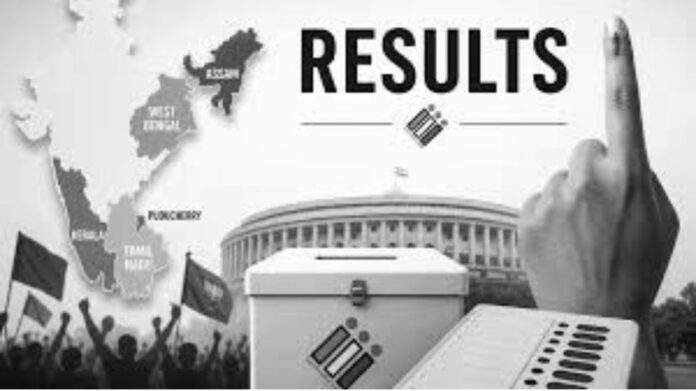
GUWAHATI, May 4: Counting of votes will take place on 4 May in Tamil Nadu, Assam, Kerala, Puducherry and West Bengal following a high-stakes contest with significant implications for major regional ruling parties such as the TMC and DMK, as well as the BJP, Congress and the Left.
The process will commence at 8 am with postal ballots at counting centres secured by a three-tier security system. For the first time, the Election Commission has introduced a QR code-based Photo Identity Card system via ECINET to prevent unauthorised access to counting centres.
In West Bengal, votes will be counted across 77 centres for 293 Assembly seats. The state has seen unprecedented security deployment this year and a particularly acrimonious build-up to results day, with both the ruling TMC and the opposition BJP voicing concerns over possible vote manipulation.
The two-phase polling in the state concluded on 29 April, recording its highest-ever voter turnout since Independence at 92.47 per cent.
The election was countermanded in one constituency — Falta in South 24 Parganas district — due to “severe electoral offences”, with fresh polling scheduled for 21 May.
Chief Minister Mamata Banerjee’s Trinamool Congress is seeking a fourth consecutive term while facing a determined challenge from the BJP. The CPI(M) and the Congress are attempting to regain a foothold after being wiped out in the 2021 polls. Smaller parties including Humayun Kabir’s AJUP and Asaduddin Owaisi’s AIMIM are also contesting key pockets.
The poll body has reduced the number of counting centres this year to 77, down from 87 announced earlier and 108 in 2021, alongside a multi-layered security arrangement.
“Comprehensive security arrangements have been made to ensure that counting is conducted in a peaceful, transparent and orderly manner,” a senior EC official said.
The EC has deployed 165 additional counting observers and 77 police observers. Strict access control measures have been introduced at counting centres, including a ban on mobile phones except for returning officers and observers.
The BJP-led NDA is aiming for a third straight term in Assam. EVMs containing the electoral fate of 722 candidates across 126 Assembly constituencies will be opened at 40 counting centres in 35 districts.
Twenty-five companies of Central Armed Police Forces, around 100 personnel each, have been deployed to guard the counting centres and the strongrooms housing the EVMs. Two additional CAPF companies will be on static duty, while 93 companies of state armed police have been deployed in the districts, officials said.
Polling in the state was held on 9 April, with a turnout of 85.96 per cent.
Of the 722 candidates, the Congress has fielded the most with 99, followed by the BJP with 90, AIUDF with 30, and NDA allies Asom Gana Parishad with 26 and Bodoland People’s Front with 11.
Among opposition alliance candidates, Raijor Dal contested 13 seats, Assam Jatiya Parishad 10, CPI(M) three, and the All Party Hill Leaders Conference two.
Prominent candidates include Chief Minister Himanta Biswa Sarma of the BJP, Congress state unit chief Gaurav Gogoi, Assembly Speaker Biswajit Daimary and Raijor Dal chief and MP Akhil Gogoi.
In Kerala, encouraged by its performance in the 2024 Lok Sabha polls and recent local body elections, the Congress-led UDF hopes to unseat the Left Democratic Front, which has governed for two terms. The BJP-led NDA is also attempting to establish a presence in the state’s traditionally bipolar polity.
A defeat for the LDF would mark the first time since the 1960s that Left parties are not in power in any Indian state.
A total of 883 candidates contested the election for 140 seats. There are 140 counting centres across 43 locations.
Officials said 15,464 personnel have been deployed for the exercise, including 140 returning officers, 1,340 additional returning officers, 4,208 micro observers, 4,208 counting supervisors, and 5,563 counting assistants.
Twenty-five companies of central forces have been deployed alongside state police personnel to guard the counting centres.
Although not in contention to form the government, the BJP-led NDA considers the election crucial to expanding its footprint in Kerala after winning no seats in 2021.
In Tamil Nadu, the ruling DMK is seeking a second consecutive term. It contested in a changed political landscape, facing not only its main rival AIADMK but also new entrants such as actor-politician Vijay’s TVK and Tamil nationalist Seeman’s NTK.
All arrangements, including a comprehensive three-tier security plan, are in place for counting on 4 May at the 62 designated counting centres across the state, said Tamil Nadu Chief Electoral Officer Archana Patnaik.
Approximately 1.25 lakh personnel, including officials, micro-observers and police on counting duty, have been deployed. A total of 234 counting halls have been arranged for EVMs, with an additional 240 halls designated for postal ballots and electronically transmitted postal ballots. In all, 10,545 counting personnel have been drafted, supported by 4,624 micro-observers.
The Election Commission has deputed 234 Counting Observers, one for each Assembly constituency, to oversee proceedings.
In Puducherry, six counting centres have been set up across the Union Territory.
The NDA, comprising AINRC, BJP, AIADMK and LJK, faces a challenge from the INDIA bloc, which includes the Congress, DMK and the VCK.
Counting will also be held in eight seats in Goa, Karnataka, Nagaland, Gujarat and Maharashtra where by-elections were held last month following the death of sitting MLAs.
The eight constituencies are: Ponda in Goa, Bagalkot and Davanagere South in Karnataka, Koridang in Nagaland, Dharmanagar in Tripura, Umreth in Gujarat, and Rahuri and Baramati in Maharashtra.
