
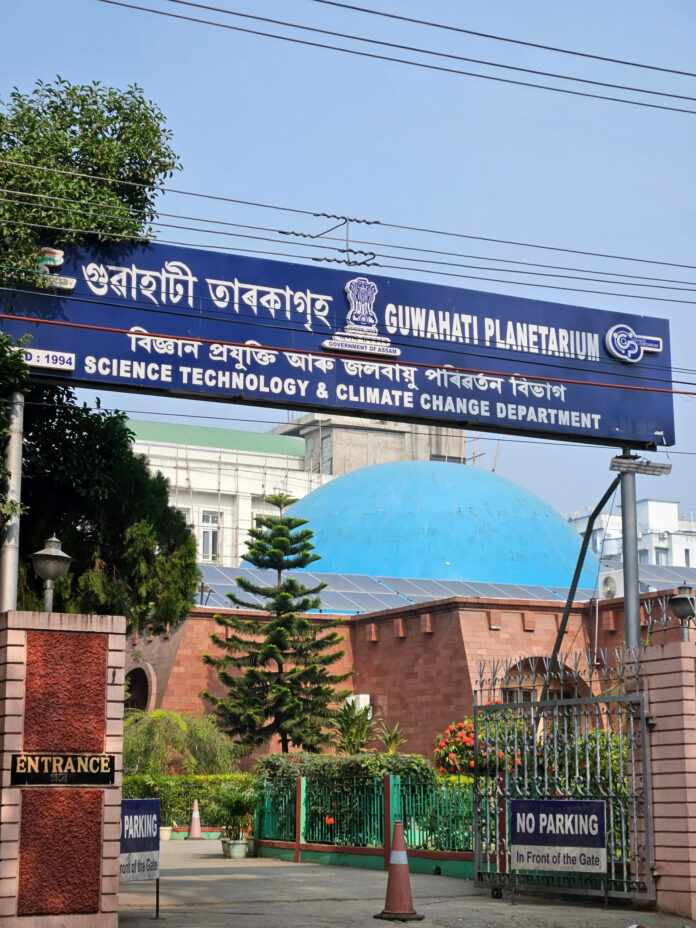
Guwahati: The Guwahati Planetarium, one of Northeast India’s prominent centres for astronomy and science education, is undergoing a major transformation, evolving from a traditional stargazing facility into a modern, technology-driven hub for scientific learning. Established in August 1994 at Uzan Bazar, the planetarium has introduced generations of students and visitors to astronomy. Managed by Assam’s Department of Science, Technology and Climate Change, it now combines public education with astronomical research and outreach activities.
Also Read: Nagaon Lok Sabha By-Poll: Banners Removed, Private Vehicles Barred at DC Office
The facility has upgraded its projection system with a Japanese Goto Chronos starfield projector and high-definition digital technology. Its full-dome theatre now offers high-resolution celestial mapping and 3D simulations, while improved audio and air-conditioning systems have enhanced the visitor experience. A new astronomical gallery and interactive Virtual Reality zone have also been added, featuring space-science exhibits, lunar models and meteorite displays. The planetarium regularly organises telescope-guided observations, seminars and educational programmes.
The centre attracts around 75,000 general visitors and more than 80,000 students annually, highlighting its importance as a regional science-learning destination. Meanwhile, construction of a four-storey Multi-Activity Centre is nearing completion. The upcoming facility will include a 15D theatre with around 46–50 seats, a science museum and an interactive space gallery. However, the planetarium continues to face challenges, including long queues during peak periods and delays in introducing an online ticket-booking system. With its ongoing expansion and technological upgrades, the Guwahati Planetarium is set to strengthen its role as a major centre for astronomy, science education and public engagement in the Northeast.
