
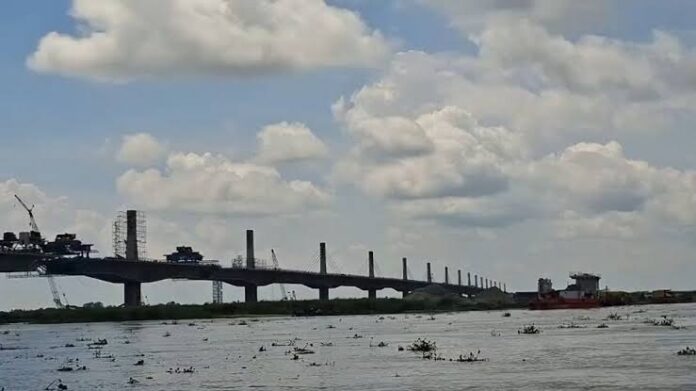
The construction of the Dhubri-Phulbari Bridge, which is set to become India’s longest river bridge and the world’s longest extradosed cable-stayed bridge over water, has reached a significant milestone with nearly 80 per cent physical progress, marking a major step towards transforming connectivity in Northeast India.
The 19.5-km bridge across the Brahmaputra River is being built by Larsen & Toubro (L&T) for the National Highways and Infrastructure Development Corporation Limited (NHIDCL). The project remains on schedule and is expected to be completed by September 2028.
Part of National Highway 127B, the bridge will establish the first permanent four-lane road connection between Dhubri in Assam and Phulbari in Meghalaya, replacing one of the region’s longest-standing transportation bottlenecks.
Engineered as a modern extradosed cable-stayed bridge, the structure combines the structural advantages of a conventional box girder bridge with cable-supported technology. Its central span extends for nearly 12 kilometres and is supported by 199 massive pillars anchored deep within the Brahmaputra riverbed.
Project officials said construction is continuing around the clock despite the challenges posed by the monsoon season. More than 250 engineers and project managers are overseeing a workforce of between 1,800 and 2,000 labourers to keep the project on track.
For years, commuters travelling between Dhubri and Phulbari have relied on ferry services that are frequently disrupted by adverse weather or have been forced to undertake a 260-km road journey that typically takes more than five hours. Once the bridge is opened to traffic, the travel distance will be reduced to around 20 kilometres, cutting journey time to just 15 to 20 minutes.
The project is expected to enhance regional connectivity by creating a seamless transport corridor linking Assam, Meghalaya, Bhutan and parts of West Bengal. It is also anticipated to improve access to healthcare, education and markets while boosting trade, tourism and logistics across the region.
Officials believe the bridge will serve as a key driver of economic growth in the sub-Himalayan region by enabling faster movement of people and goods, making it one of the most significant infrastructure projects undertaken in Northeast India.
