
Satyabrat Borah
satyabratborah12@gmail.com
The sun over India has been unforgiving lately. It is not just the usual sticky, heavy heat that we have grown up with. It feels different now, sharper and far more aggressive. When a place like Sri Ganganagar in Rajasthan hits forty-eight degrees Celsius, it stops being just a weather update on our phones. It becomes a survival challenge. We often blame delayed monsoons or talk about global warming as a distant problem. But the real enemy is much closer to home. It is right under our feet, in the walls around us, and in the choices we make every day while building our cities. We have trapped ourselves in a cage of our own making, and we can call this condition a concrete fever. For decades, our response to development has been to pour cement over everything that breathes. We cut down trees, pave over ponds, and replace patches of grass with black asphalt that absorbs heat like a giant sponge. When the sun beats down on these hard surfaces all day long, they store heat and release it back into the air long after sunset. This is why our nights in the city do not bring the relief they used to. We have built giant heat magnets and now we are wondering why we are burning.
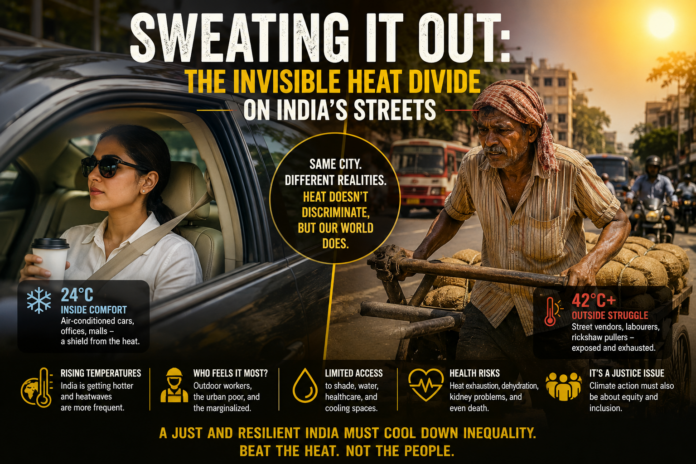
The way we live and work in these environments shows a deep divide in our society. If you are fortunate enough to work in an air-conditioned office, your response to the heat is simple: turn down the temperature and create a tiny bubble of comfort. But this comfort comes with a hidden cost. An air conditioner does not actually destroy heat. It simply takes the heat from inside your room and pumps it outside. It consumes large amounts of electricity and blows hot air into the streets. The thousands of cooling units hanging from buildings are acting like tiny flamethrowers, making the shared air of the city warmer for everyone else. The machine you bought to save yourself is actively making the world outside worse for your neighbors. The people who bear the brunt of these choices are those who keep society running. Construction workers, street vendors, delivery riders, sanitation workers, and traffic police spend hours under the open sky. They do not have the luxury of staying indoors. For them, the heat is not an inconvenience; it is a physical assault.
We need to start having an honest conversation about how we design our habitats. We cannot rely on individual gadgets to save us from a collective disaster. Buildings should use reflective materials, white roofs, and cooling designs that reduce heat absorption. If a building does not absorb heat in the first place, it does not need a massive air conditioner to cool it down later. Alongside reflective surfaces, we need to bring back the green cover we so carelessly destroyed. Trees are not just decorations. They are active infrastructure. A mature tree acts like a natural cooling tower, providing shade and releasing moisture into the air. When you walk under a canopy of trees on a hot day, you feel an instant drop in temperature that no artificial fan can replicate. Extreme heat must be treated as a public health emergency. Public cooling shelters, drinking water stations, better urban planning, and stricter protection for outdoor workers are no longer optional. The concrete fever is a warning sign from our environment. We can either listen to this warning and change our design, or we can keep turning up the air conditioning until the system collapses underneath us.
(Contract No. 9854372736 )
