
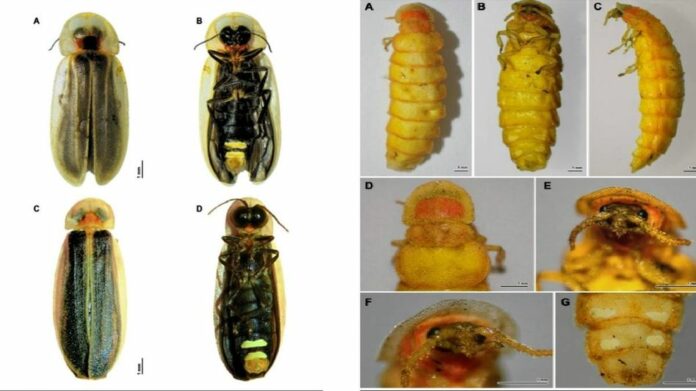
Shillong, April 30: A team of researchers has identified two previously undocumented species of fireflies in East Khasi Hills, marking a significant scientific breakthrough and closing a gap of more than a century in the study of the genus Diaphanes in India.
The newly recorded species, named Diaphanes meghalayanus and Diaphanes mawlynnong, were discovered in undisturbed forest ecosystems across the Khasi Hills. The research was led by Emma Magdalene Nonglang along with a multidisciplinary team including Chandana Dammika Wijekoon, Memorial Ryndong, Dhiraj Kumar Das, Samrat Sengupta and Jane Wanry Shangpliang.
Field observations were conducted in semi-evergreen forests, bamboo groves and dense canopy regions near rocky streams—habitats characterised by low human interference. According to the researchers, the naming of the species reflects both regional geography and cultural identity. While D. meghalayanus denotes its broader distribution across Meghalaya, D. mawlynnong is named after Mawlynnong, recognising the local Khasi community where it was first documented. Locally, fireflies are referred to as “Niangbading”.
The study highlights distinct ecological preferences of the two species. D. meghalayanus was observed in February within semi-evergreen forests and betel nut plantations, favouring temperatures between 18 and 20 degrees Celsius and humidity levels of 77 to 80 per cent. It emits a faint green pulsating glow while flying at heights of approximately 10 to 15 metres.
In contrast, D. mawlynnong appears to occupy more specific habitats, thriving in dense forests with heavy bamboo cover and rocky stream environments. Researchers documented a wingless female beneath a boulder, noting its slower and longer light pulses—an observation that provides valuable insight into the species’ behavioural patterns and life cycle.
The findings also underline the importance of darkness for firefly survival. Scientists observed that populations were more visible in remote forested areas, while sightings declined significantly in regions affected by artificial lighting.
With these additions, the number of recognised Diaphanes species in India has increased to 15, reinforcing the ecological importance of Meghalaya’s forest ecosystems and the need for their continued preservation.
